This months RSPB Field Trip was through one of England’s surviving lowland raised peat landscapes did not result in the longest list of bird sightings although there was so much more to see: carnivorous plants, prehistoric archaeology, aerial hunters and one particularly memorable encounter on the path.
A grey heron was already waiting for us when we arrived at Boston Park, flying over the car park as though it had been sent to welcome visitors to Hatfield Moors.
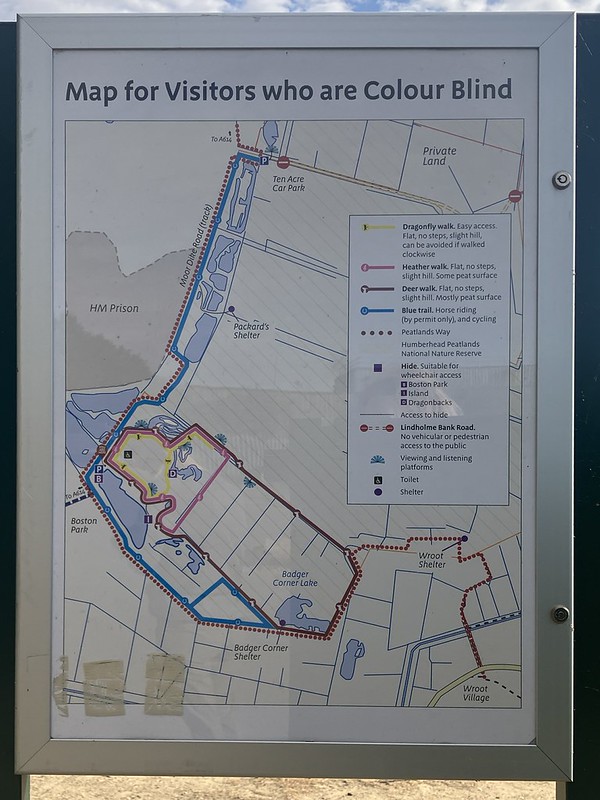
We had arrived early for a field trip to the wider Thorne and Hatfield Moors landscape, part of the Humberhead Peatlands National Nature Reserve near Doncaster. With time before the group assembled, we decided to follow the short yellow trail and gain a feeling for the reserve.
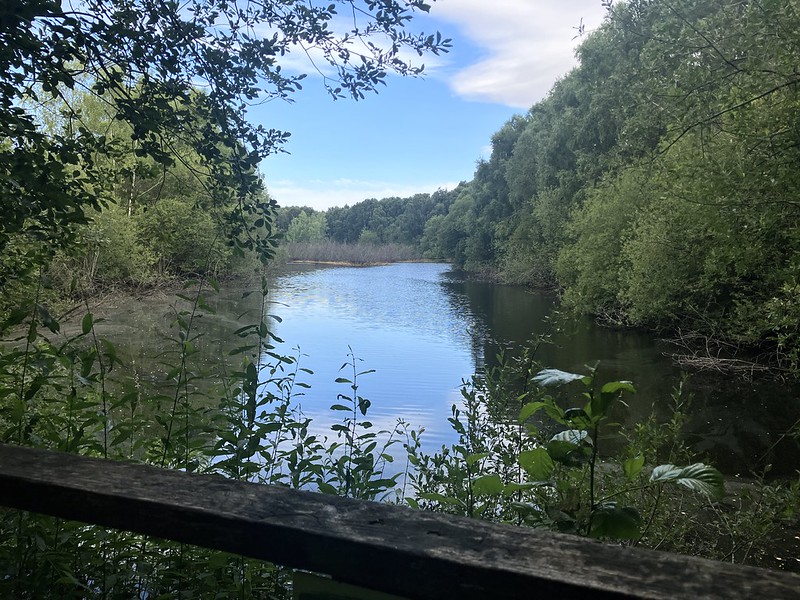
It was immediately apparent that this was not going to be a conventional country walk. Hatfield Moors is a landscape of peat pools, birch woodland, reed fringed water, drainage channels and broad open spaces. Although after the driest July I can remember there was very little water and many of the pools and bogs had completely dried up.
This is a landscape that has been altered repeatedly. Peat formation began over thousands of years as waterlogged, acidic conditions slowed the decay of mosses and other vegetation. Much later, drainage and industrial peat extraction lowered the water table and damaged large areas of the bog. Today, restoration involves holding water back, blocking drainage channels and trying to recreate the wet conditions needed by specialist peatland plants and wildlife.
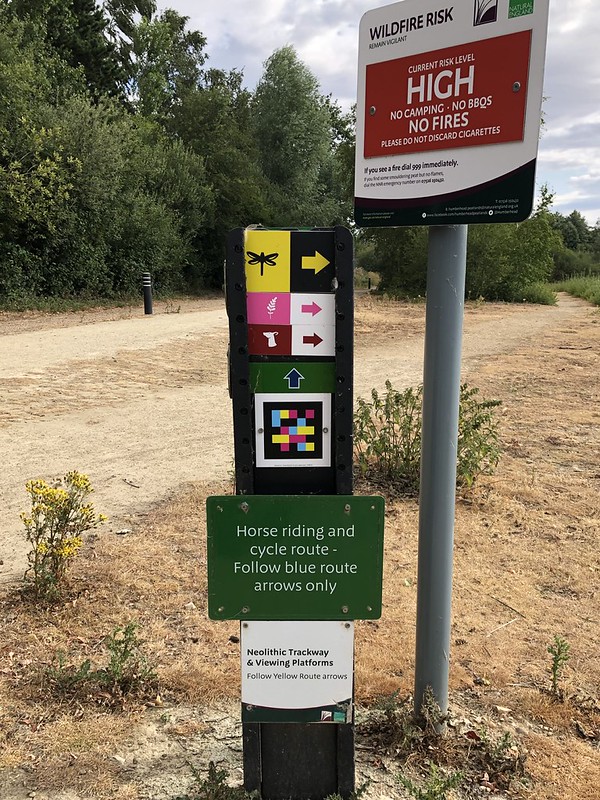
On the morning of our visit, however, the ground looked surprisingly dry. A prominent sign declared the wildfire risk to be high, banning fires, barbecues and camping. Against the pale, dry vegetation around the entrance, the warning did not feel remotely theoretical.
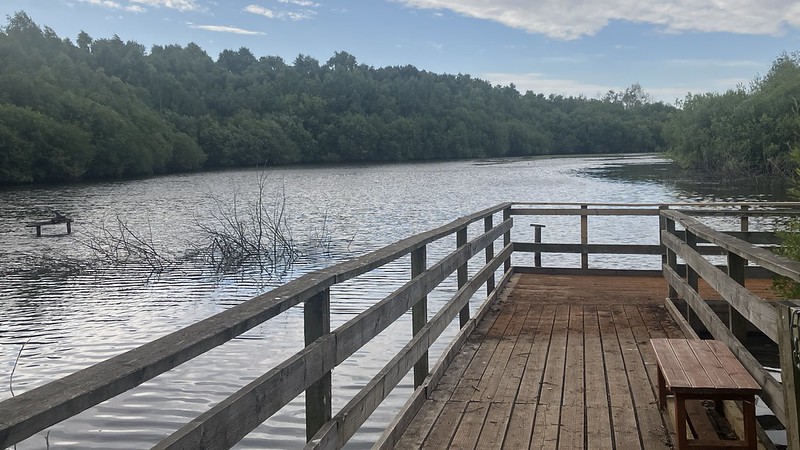
Our first stop was one of the hides overlooking the water. Another heron was visible from the island hide, this time accompanied by graylag geese.
The hide itself seemed set a little too far back to provide a perfect view. It was also sad to see what appeared to be damage to the roof, perhaps caused by people climbing on it. In a place where infrastructure is intended to help visitors experience wildlife without disturbing it, that sort of damage feels particularly unnecessary.
Continuing around the yellow route, we passed through a woodland area. Somewhere among the trees above us, a blackcap was singing. As so often happens, the voice was far easier to locate than the bird itself, so the singer remained frustratingly elusive.
On the water, through a web of vegetation a small dark bird prompted an inconclusive identification discussion. Was it a young coot, a little grebe or perhaps a young tufted duck? Sometimes birdwatching ends with a confident name; sometimes it ends with several possibilities and a decision to keep looking. There were fewer doubts about the moorhens and mallards further along.
By the time we returned towards the car park, the rest of the field trip group had begun to gather. Our early lap had given us a useful sense of the reserve.
With the group assembled, we headed down to the hide close to the car park.
Little grebes and coots moved across the water, while sand martins hunted above it. Lapwings appeared around the margins, and great crested grebes provided one of the morning’s most charming sights: their striped youngsters, looking like tiny floating humbugs.
There is something restorative about sitting quietly in a hide and simply looking across water. The pressure to move disappears. Small movements begin to reveal themselves: a bird surfacing, a shape crossing the reeds or a sudden change in the behaviour of everything on the lake.
From there, we passed the composting toilet and almost immediately found the blackcap, although probably not the same one that had escaped us earlier. This time it was a female, feeding on berries in a tree directly in front of us.
Soon we were back to peering into bushes. Goldfinches drew most of our attention, although chaffinches were also spotted among the foliage.
The morning was developing not as a quest for a single rarity, but as a series of small observations. Each species added something to the character of the place.
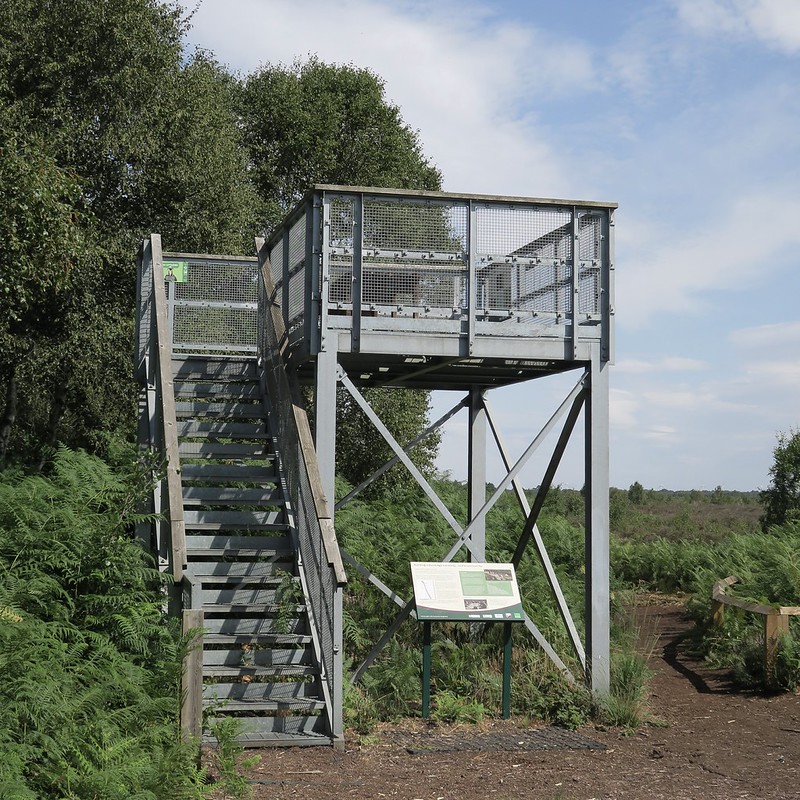
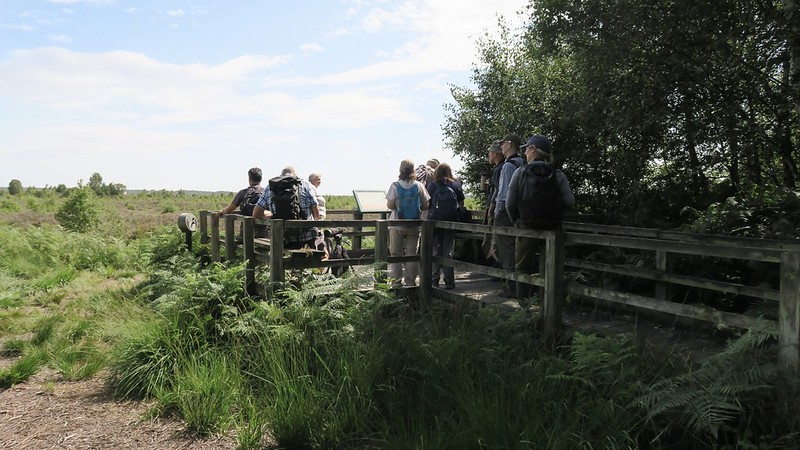
A quiet woodland path led us towards one of Hatfield Moors’ most unexpected features: a viewing tower and a reconstruction of a Neolithic timber trackway.
The original Lindholme trackway was discovered within the peat and investigated archaeologically between 2004 and 2006. Radiocarbon dating placed it at approximately 2900 to 2500 BC, during the Late Neolithic period.
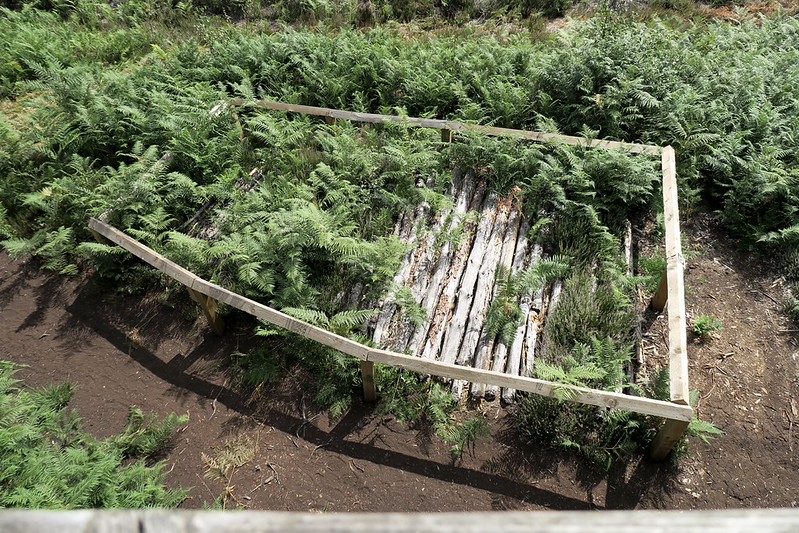
The excavated remains indicated a structure roughly 45 metres long, built principally from Scots pine. A narrower track appears to have widened into a platform, with a threshold of silver birch found at its northern end.
It may have allowed people to cross increasingly wet ground, but the structure appears to have been more elaborate than a simple path. Archaeologists have suggested that the platform may have held social, symbolic or ritual significance.
The original timber remains have been reburied and rewetted to protect them. What visitors see today is a reconstruction created in 2019 by local volunteers working with archaeologists and experimenting with traditional tools and methods.
Now partly swallowed by bracken and other vegetation, the reconstruction gives a useful impression of how timber could gradually disappear into a wetland. In waterlogged, oxygen poor peat, fragments of wood may then survive for thousands of years.
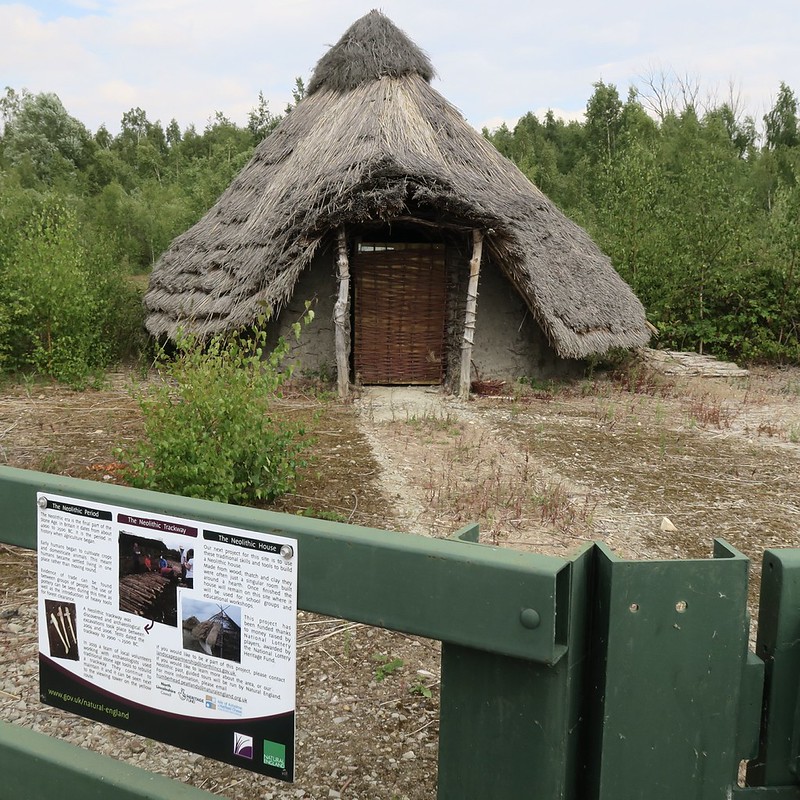
Nearby the car park stands a reconstructed Neolithic house, built from timber, woven panels, clay and thatch. It does not represent a house excavated at that exact spot, but it helps interpret the wider human story of the landscape.
Five thousand years ago, this was not yet the open peat bog that later developed. The surroundings would have included woodland, pools, heath and increasingly wet ground. The trackway and house encourage visitors to imagine people living within a landscape that was itself changing around them.
From the viewing tower, we could look across the modern bog. It was not looking especially boggy that day, because of the prolonged dry conditions. Standing in the shade, we watched lesser black backed gulls and swallows overhead. The landscape seemed generally quiet, although quiet rarely means empty.
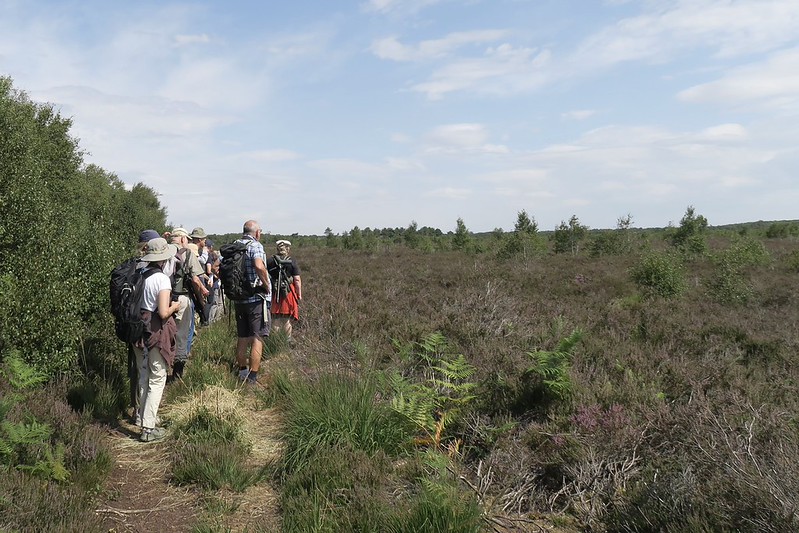
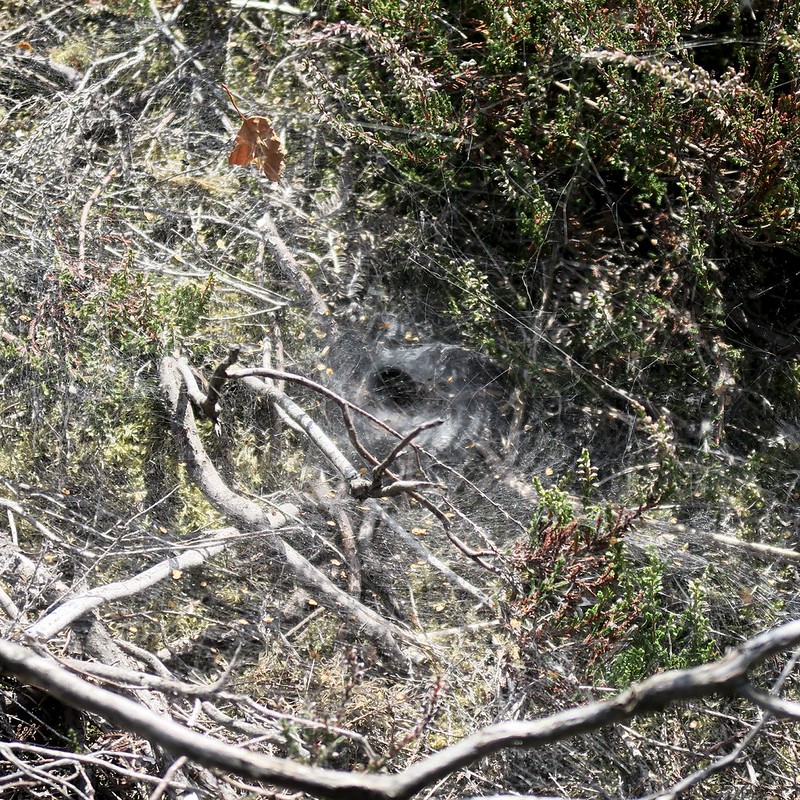
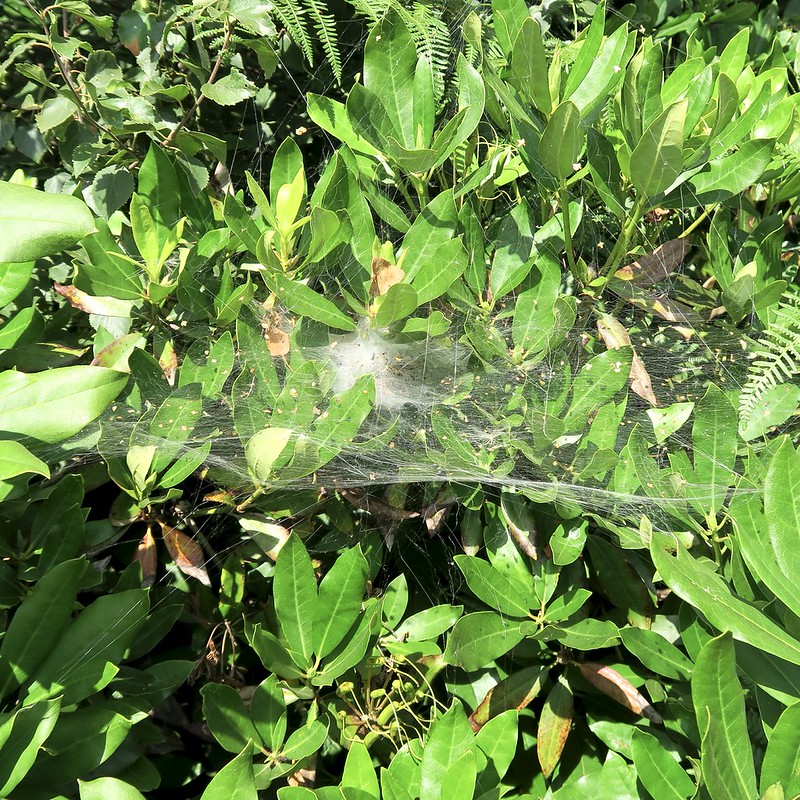
We continued with woodland on one side and open ground on the other, regularly stopping to observe spider webs. These were not the typical webs between branches, but distinctive three dimensional structures, likely created by labyrinth spiders.
Carrying on, chaffinches and long tailed tits moved through the trees, stonechats resting on top of young trees, while dragonflies patrolled the sunnier edges. Hatfield Moors is known for its dragonflies, and the reserve’s accessible yellow route is appropriately called the Dragonfly Walk.
Their constant movement offered a contrast to the hidden or distant birds. Some paused briefly, but many appeared only as flashes of colour and light before changing direction and vanishing across the vegetation.
Back on the yellow trail, the hide we had visited earlier now produced swans, coots and grebes. Greylag geese, with their substantial orange bills, were feeding and resting nearby.
Then came a more dramatic call: hobby.
High above the trees, the elegant falcon appeared before dropping lower towards the water. Hobbies are fast, agile hunters, capable of catching dragonflies and small birds in flight. In a reserve alive with aerial insects, their presence made perfect sense.
Almost as though another bird of prey had heard the excitement, a kestrel soon joined the display, hovering above the landscape while searching for prey.
For a trip taking place outside the main migration periods, we had seen a satisfying range of birds. Yet one of the day’s best discoveries was not a bird at all.
When walking around with the group, we had spotted a yellow flower in the water, although we had not quite managed to identify it before moving on. After the main group returned to the car park and headed home, we decided to revisit the yellow flower noticed earlier in one of the peaty pools.
It was an unusual looking plant. Small yellow flowers, each less than a centimetre across, were arranged alternately along reddish brown stems rising above the water. Some flowers appeared in pairs, facing in opposite directions. No obvious floating leaves were visible.
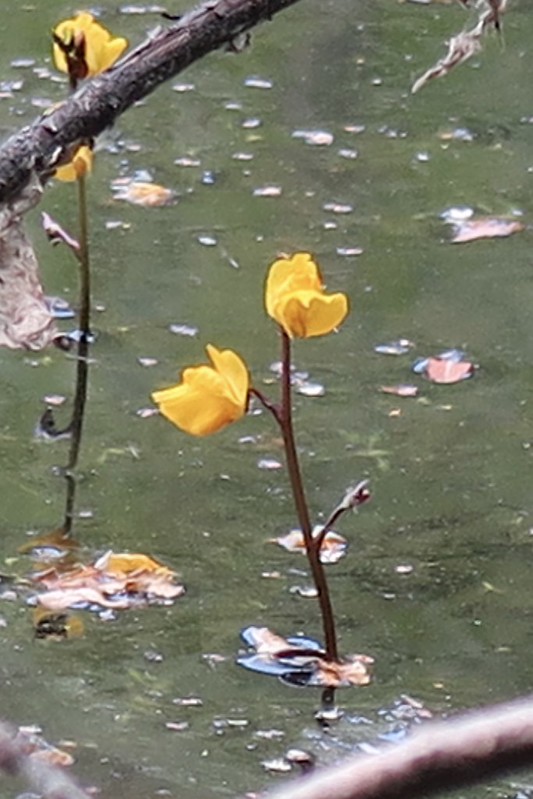
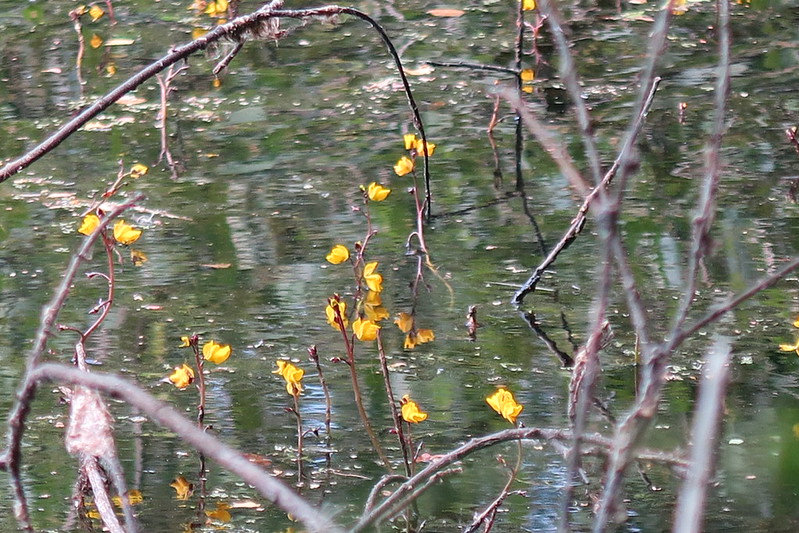
We stood at the edge of the pool, using binoculars to examine the plant without disturbing it. Gradually, by combining its shape, size and habitat, we narrowed the possibilities.
It was a bladderwort, one of Britain’s carnivorous aquatic plants.
Most of the plant remains underwater, which explained the apparent absence of leaves. Beneath the surface, its finely divided shoots carry tiny bladder shaped traps. These create suction and capture microscopic aquatic creatures, supplementing the limited nutrients available in acidic bog water.
For me, this was one of the day’s real highlights.
It was not simply the identification itself. It was the process: noticing something unfamiliar, looking carefully, discussing the visible features and slowly reaching an answer. I love this way of learning about the natural world. Instead of immediately attaching a name to something, observation becomes a shared investigation.
The afternoon was still young.
Having completed the yellow loop before the group arrived and then covered much of the pink Heather Walk with everyone else, we decided to continue around the brown Deer Trail.
This would take us past another viewing platform raised above the landscape before curving towards Badger Corner Lake and its shelter.
Partway along the trail, I noticed a twig move. Except it was not a twig. An adder was lying on the path.
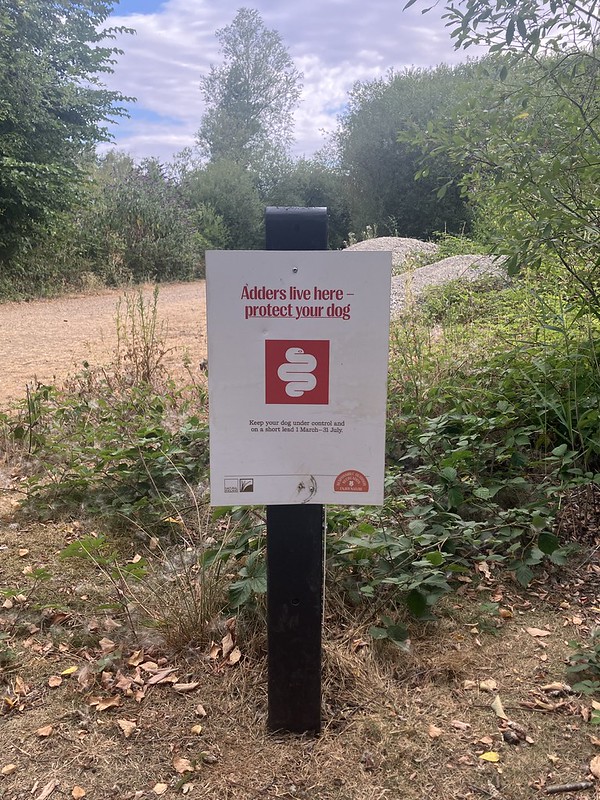
In my excitement, I stopped my partner and pointed it out. With all the time I spend outdoors, adders are animals I encounter remarkably rarely. We had passed warning signs asking dog owners to keep their pets under control because adders lived on the reserve. I had half wondered whether the warning was simply intended to encourage more responsible behaviour around wildlife.
The snake on the path removed any doubts.
My partner initially thought I had stopped her because I was gallantly protecting her from a venomous snake. I agreed that this was, naturally, exactly what I had been doing. In truth, I was mostly delighted to see such an elusive animal.
Britain’s only native venomous snake is usually shy and avoids people when given the opportunity. This one soon slipped away from the path and disappeared into the vegetation, leaving us to continue towards Badger Corner Lake. It was a brief encounter.
We knew before arriving that this might not be the sort of field trip on which we recorded the greatest number of birds or found a spectacular migrant rarity.
Yet nature rarely follows the planned theme of the day.
Hatfield Moors delivered a female blackcap feeding close by, grebes with humbug striped young, hunting hobby and a hovering kestrel. It gave us herons, geese, lapwings, sand martins, goldfinches, long tailed tits and dragonflies.
It also gave us a carnivorous plant flowering quietly above dark water, a glimpse of a real adder and a trackway connecting the modern reserve with people who crossed this changing landscape around five thousand years ago.
The most memorable field trips are not always those with the longest species lists. Sometimes they are the ones that encourage you to stop, look more closely and understand how wildlife, landscape and human history have become intertwined.
Hatfield Moors did exactly that.