There are worse ways to begin a field trip than being welcomed by a Chiffchaff calling from the car park.
That was how our day began at Yorkshire Wildlife Trust’s North Cave Wetlands, near Hull. The sun was already bright, the reserve was full of spring life and our group slowly gathered beside the Wild Bird Café, although sadly on this occasion the café itself was not there. Still, with flasks, packed lunches, binoculars and good company, we had everything we needed for a day exploring one of East Yorkshire’s most interesting wetland reserves.
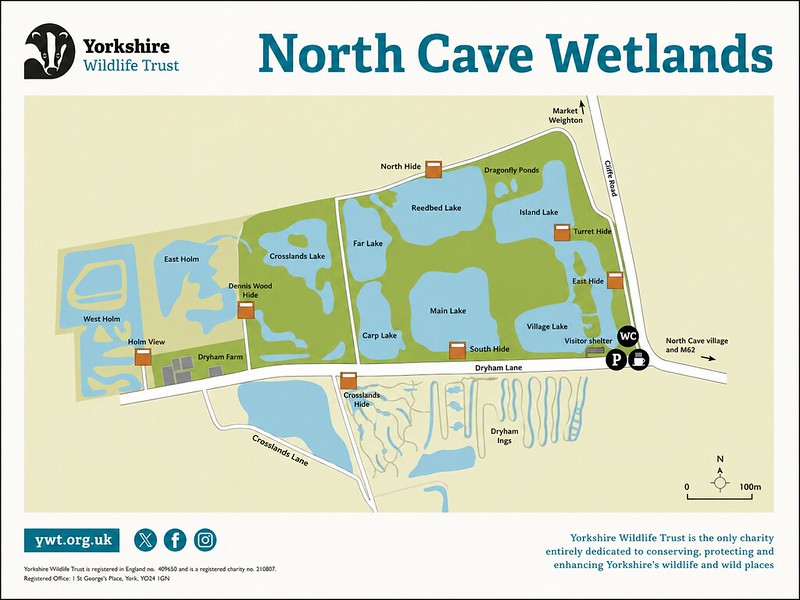
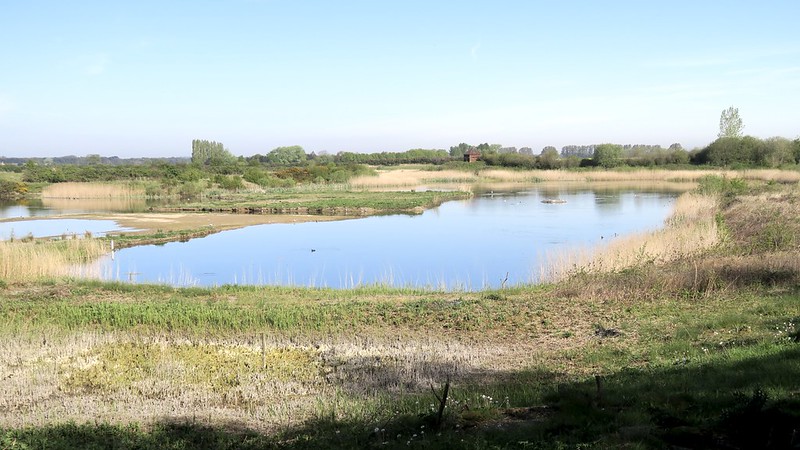
We began gently viewing from the covered visitor shelter viewing platform. It was the kind of place that encourages you to slow down straight away. There was no need to rush into the reserve when there was already so much to see from where we stood. On the water were Tufted Ducks, Coots, a Mute Swan, Moorhen and a Grey Heron standing quietly on the edge of the reeds. Greylag Geese were busy being Greylag Geese, including one chasing another away, while two Coots had a little disagreement of their own. These small dramas are part of what makes a field trip so enjoyable. Even familiar birds become interesting when you take time to watch what they are actually doing.
At one point we wondered whether a small, erratic shape on the water might be a Little Grebe. Without binoculars it seemed possible for a moment, until the rest of the family came into view and revealed it to be a Mallard duckling. It was a lovely reminder that birdwatching involves a fair amount of hopeful guessing, followed by correction, laughter and learning.
We were briefly distracted by a Blue Tit leaving its nesting box on the decking, before a group of black and white waders arrived. On closer inspection they proved to be Oystercatchers. Nearby we picked out Shelduck resting, Ringed Plover, Black-headed Gull and Wigeon, including two males and a female. A Buzzard passed through the sky above us, while a pair of Great Crested Grebes swam elegantly down towards our viewpoint.
One of the quieter highlights of this early part of the day was a Common Sandpiper, beautifully camouflaged along the water’s edge. It made its way steadily along the shoreline, easy to miss until you knew exactly where to look. Two Cormorants then flew in, adding to what was already becoming a very good start.
From the visitor shelter we began to work anticlockwise around the reserve, continuing to looking over Island Lake and then making our way towards East Hide. Here we had a second view of the Common Sandpiper and then a particularly lovely view of a Snipe. As always, the Snipe had that magical quality of seeming both obvious and invisible at the same time. Once pointed out, it was clear enough. Look away, and it almost disappeared back into the background and then it did disappear into the undergrowth.
As we moved on towards the Turret Hide, a Whitethroat showed itself, another sign that spring had properly arrived. The reserve was not only about open water. The scrub, hedges and reeds were all alive with movement and song. The Turret Hide was perhaps my favourite part of the morning. Looking south from the raised hide, I spotted movement in a break in the reeds. This time the Little Grebe did not disappoint. It dived and reappeared, doing what Little Grebes do so well, vanishing completely and then popping up somewhere else.
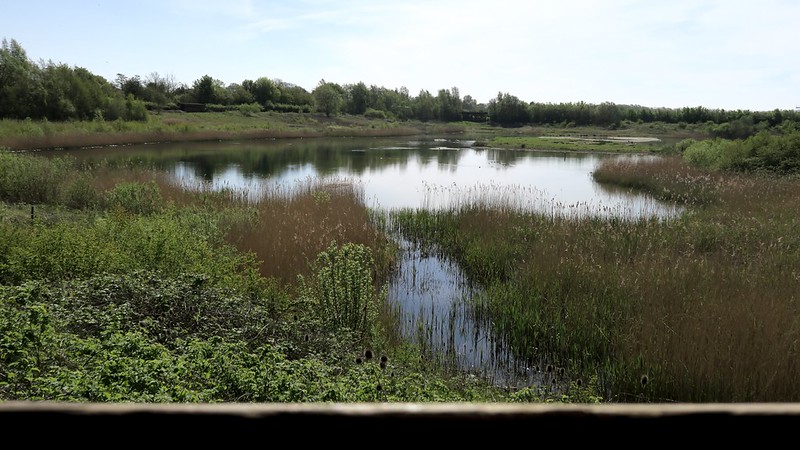
This little patch of reeds became one of those places where it was worth staying still for a while. A Reed Warbler was moving low in the reeds just in front of us and a Reed Bunting appeared in the bush beside the hide. There was also some discussion about Cetti’s Warbler. It was not confirmed at that point but the possibility lingered in the background of the day as we continued to hear its song on and off all day.
By now the list was growing steadily: Black-headed Gull, Blue Tit, Buzzard, Chiffchaff, Common Sandpiper, Coot, Cormorant, Goldfinch, Great Crested Grebe, Grey Heron, Greylag Goose, Lapwing, Little Grebe, Mallard with young, Moorhen, Oystercatcher, Reed Bunting, Reed Warbler, Ringed Plover, Robin, Shelduck, Snipe, Teal, Tufted Duck, Whitethroat and Wigeon.
From there we chatted our way through Snipe Field and past the small ponds, which looked ideal for dragonflies and damselflies later in the season. Even though birds were the main focus of the trip, this part of the reserve reminded me that North Cave is much more than a birding site. It is a mosaic of wetland, grassland, scrub, pools and recovering worked land.
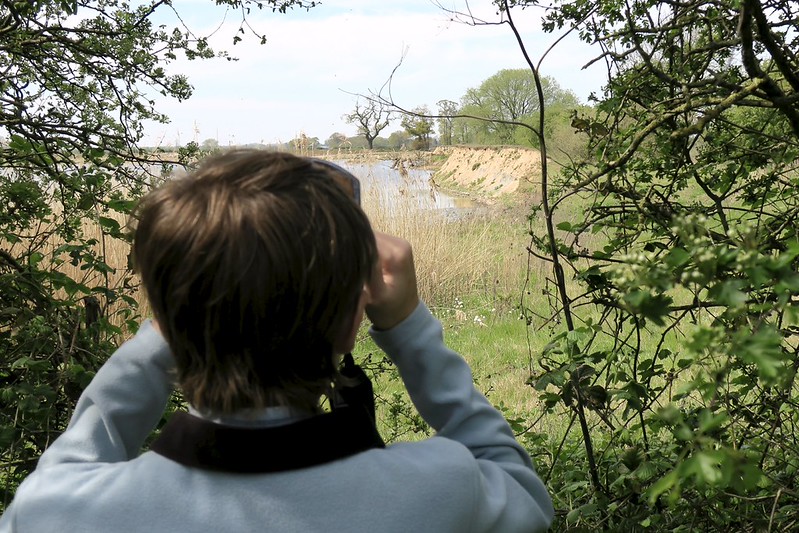
We continued round past Reedbed Lake, North Hide and Far Lake. From the far corner of the reserve we paused to watch Sand Martins coming in and out of the sandbank. It was one of the most satisfying sights of the day: birds full of purpose, constantly arriving, disappearing and returning again. From here we could also look towards what is, or has been, another phase of the reserve following sand and gravel extraction. It will be fascinating to see how this land changes over the coming years and decades. North Cave feels like a place still becoming itself, not simply a finished reserve.
A Blackcap then appeared close by while we were trying to identify a butterfly. Eventually we had enough of a view to think the butterfly was probably a Green-veined White. A little further on I found myself looking more closely at the flowers as well. It brought back a clear memory of a previous visit here with my daughter, when we had stopped in the same area with a flower identification guide, trying to work out what we were looking at. It was nice to pause there again, enjoy the plants and reminisce a little.
By the time we reached Crosslands Hide, lunch was very welcome. It is a lovely big hide and to be honest we focused as much on food, hot drinks, cake from our group leader and a brief escape from the increasingly hot sunshine as we did on new sightings. An Orange-tip butterfly passing the window gave us a bright spring moment while we rested.
After lunch we headed on to Dennis Wood Hide. A Dunnock showed in the hedge nearby but on arriving at the hide the real bonus here was a knowledgeable local who helped point out the Mediterranean Gulls among the many Black-headed Gulls. It was a useful comparison. The Black-headed Gulls were really more brown-headed, while the Mediterranean Gulls had much deeper black hoods and red bills. This part of the reserve gave us some of the best birds of the day. We saw Avocets, which were probably my favourite sighting, along with Mediterranean Gull, Black Terns, Common Tern, Little Ringed Plover, Oystercatchers, Tufted Ducks, Lapwings, Coots and Moorhens. The Little Ringed Plover gave a particularly good view on the rocks below the hide, with the yellow eye-ring helping distinguish it from Ringed Plover.
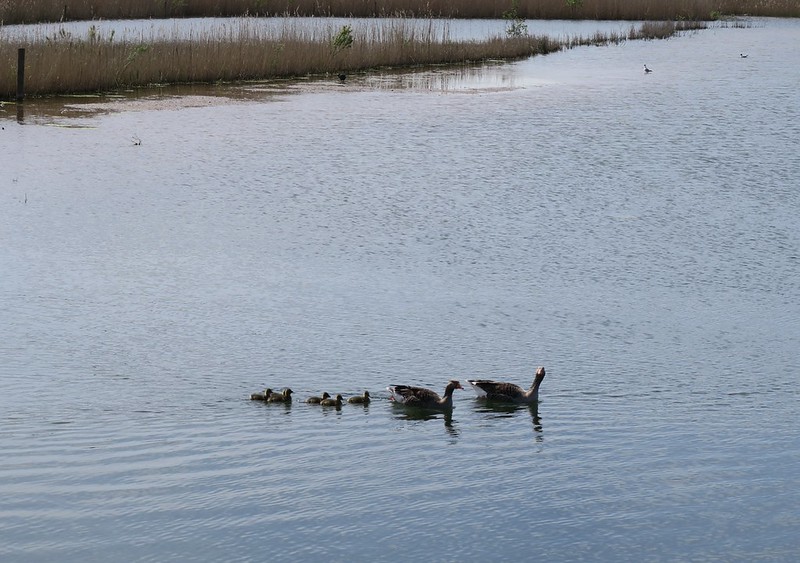
There were sleeping Avocets on the bank, Shelducks on the water, more Great Crested Grebes all close enough to appreciate properly. Others also picked up Red-crested Pochard here, although I managed to miss it at this point, one of those small frustrations that come with birding in a group. Sometimes you are almost in the right place at almost the right time. From Dennis Wood Hide the group continued towards Holm View, while I lingered slightly longer to try to pick up the Common Tern before catching up with my family and the rest of the group.
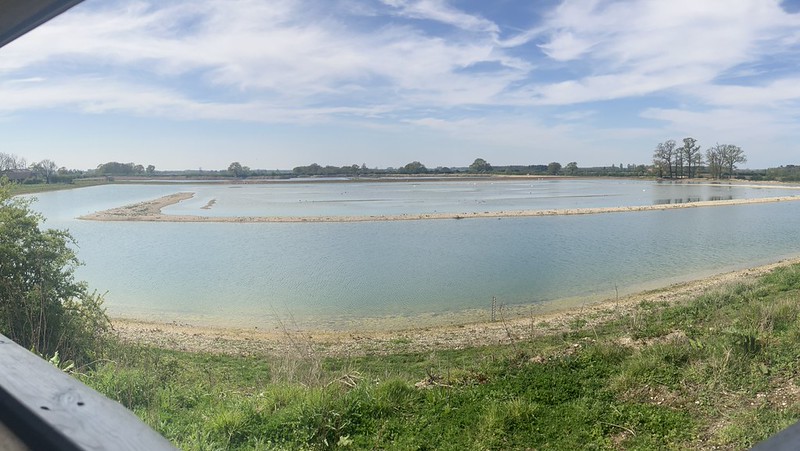
At the screen near Holm View, we added Lesser Black-backed Gull and saw Lapwing again. The Red-crested Pochard was spotted once more, this time with its red bill and brown head showing well as from this angle the light was just perfect for viewing this beautiful bird. A pair of Red-legged Partridge also made a brief appearance, running up from the water towards cover on the bank. By this point the group was beginning to thin out as people started to head home. A smaller group of us carried on towards South Hide. Walking back past the farm we heard Cetti’s Warbler and this time it was spotted giving a satisfying resolution to the earlier discussion.
We stopped again at a hide overlooking another patch of water, with a view back towards Turret Hide. For me, this was one of the nicest parts of the day. There was less pressure now to find something new. Instead, it became more about sitting with birds we had already spent time with, watching behaviour rather than just adding names to a list and relaxing into the tail end of the field trip.
Eventually we made our way back onto Dryham Lane and towards the cars, picking up snacks to eat by the visitor shelter. One by one, people had peeled away until only a smaller group remained. A Brimstone butterfly provided a final bright note as the day drew to a close. This was a genuinely lovely field trip. North Cave Wetlands gave us a rich mix of birds, butterflies, flowers, hides, open water and reedbeds, all under increasingly warm spring sunshine. But as with so many of these trips, the pleasure was not just in what we saw. It was in the shared looking. Someone spotting a bird you would have missed. Someone helping with an identification. Someone pointing out the difference between a Ringed Plover and a Little Ringed Plover, or a Black-headed Gull and a Mediterranean Gull.
For those who have not yet been to this reserve, North Cave is well worth a visit. It is a reserve that rewards slow attention, whether you are watching Avocets on the bank, Sand Martins at the sand banks, a Little Grebe in the reeds or simply enjoying the company of a group of people who like to stop, look and notice.
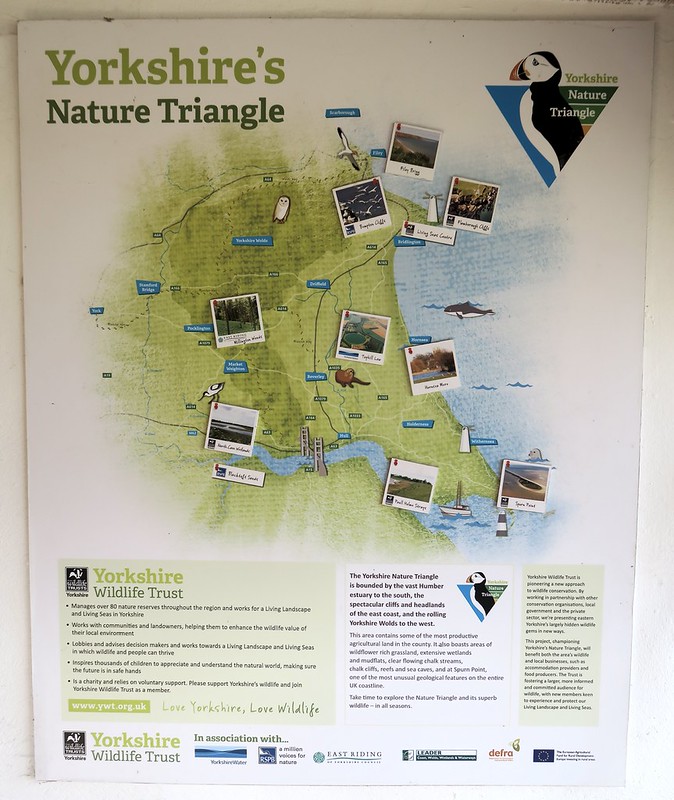
Really like this idea of the Yorkshire Nature Triangle. It’s a great reminder of just how much there is packed into this part of the world.
We’ve made a bit of a tradition of our annual trip to RSPB Bempton Cliffs. I am not sure I will get tired of watching gannets at eye level and our slightly more “character-building” visit to Spurn Point in a storm still stands out for all the right (and slightly windswept) reasons.
RSPB Blacktoft Sands is another favourite for us always feels like a birders bird reserve and love sitting by the fire watching and chatting.
A couple that feel like they could sit nicely on this map as well:
Far Ings Nature Reserve: which has been brilliant for bitterns and spring birdlife
Alkborough Flats: a great spot, especially for bearded tits (or bearded reedlings depending on which name you go with!)
I’ve written up a few of these trips already, nice to be reminded there’s a bit of a personal map building up alongside the official one.