Dresden
The journey began in the familiar grey of a British winter, rolling steadily south by train towards Heathrow. We spent the night at the Holiday Inn Express at Terminal 4, a surprisingly calm pocket of comfort on the edge of one of the world’s busiest transport hubs. By morning, we were travellers again, setting out for Terminal 5 with the quiet confidence that comes from assuming everything will run smoothly.
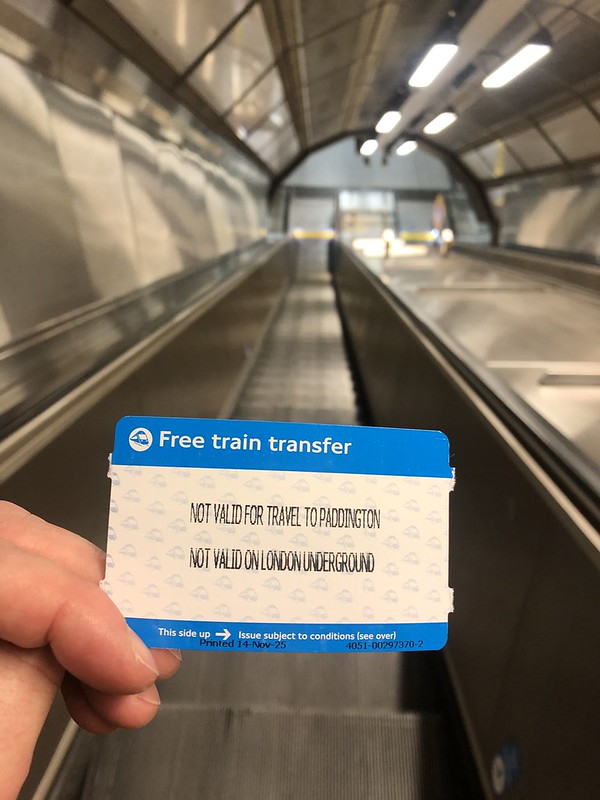
That confidence lasted exactly one train.
Standing on the platform waiting for our connection, a crackling announcement broke the spell: a train had failed in the tunnel ahead. No estimate. No guidance. After a brief pause and a shared glance, we abandoned the platform and went in search of another way across the airport. Salvation came in the form of a bus driver, who gave us a lift.
Security was painless. After a short wait at the gate, we were airborne and heading south.
Landing in Berlin, we caught a train to the central station and then boarded another for Dresden, the first stop on our journey into Saxony.
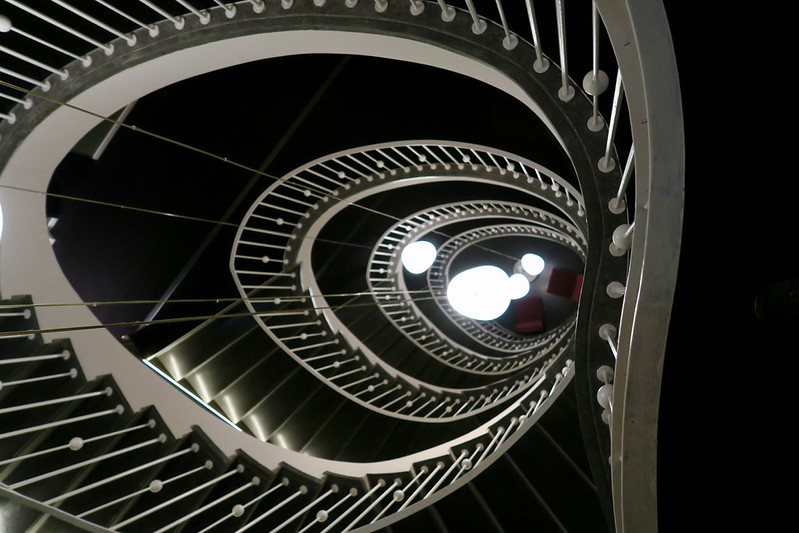
Our base for the next two nights was the Holiday Inn Dresden Am Zwinger, a modern, quietly sophisticated hotel just a short walk from the historic core. An unexpected upgrade to an executive room added a touch of ease and space, a welcome luxury after the journey.
We didn’t linger indoors for long. As the winter light began to fade, we headed straight out, slipping into the Zwinger Palace courtyard just before closing. The courtyards were almost empty, the Baroque façades glowing softly without the need for crowds or commentary. From there, we wandered past Theaterplatz through the surrounding squares, picked up a few essentials from a local supermarket before returning to the hotel for an early night.
It was an unassuming first evening although a perfect introduction: calm, unhurried and rich with the sense of a city waiting to be explored.
On the second day, we began by skirting the moat that wraps around the Zwinger, tracing its outer edge. From there, the route carried us past the Semperoper (opera house), its confident stone façade anchoring Theaterplatz, before continuing alongside the Kathedrale St. Trinitatis.
Running along the outer wall of the Residenzschloss, we encountered the vast porcelain procession of the Fürstenzug. Eight centuries of Saxon rulers unfold here.
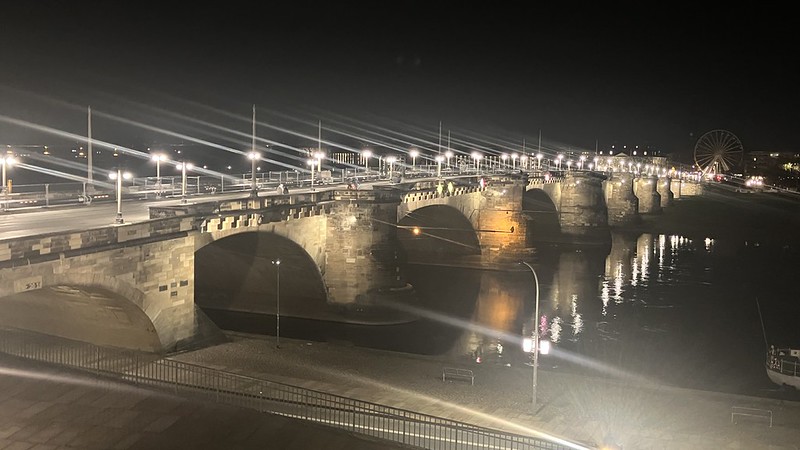
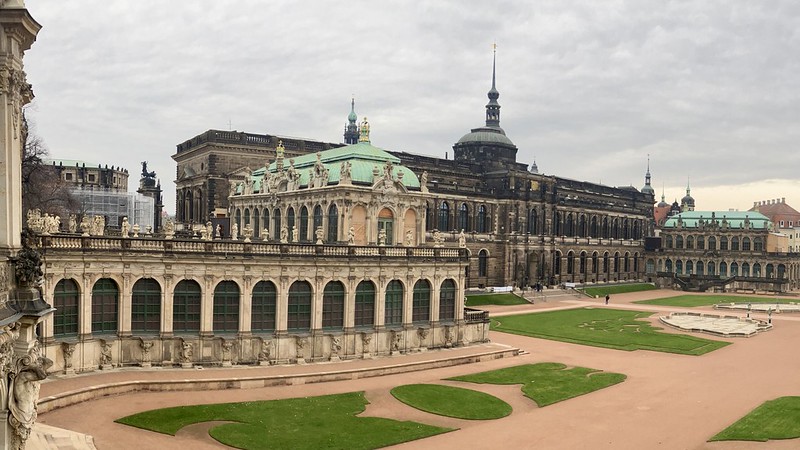
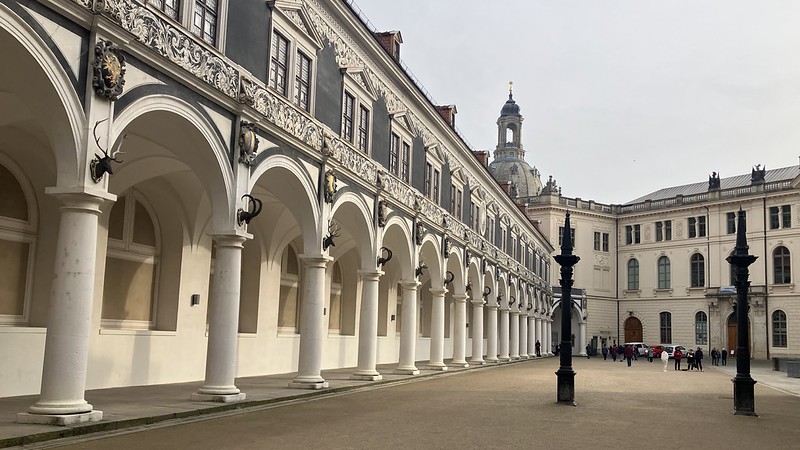
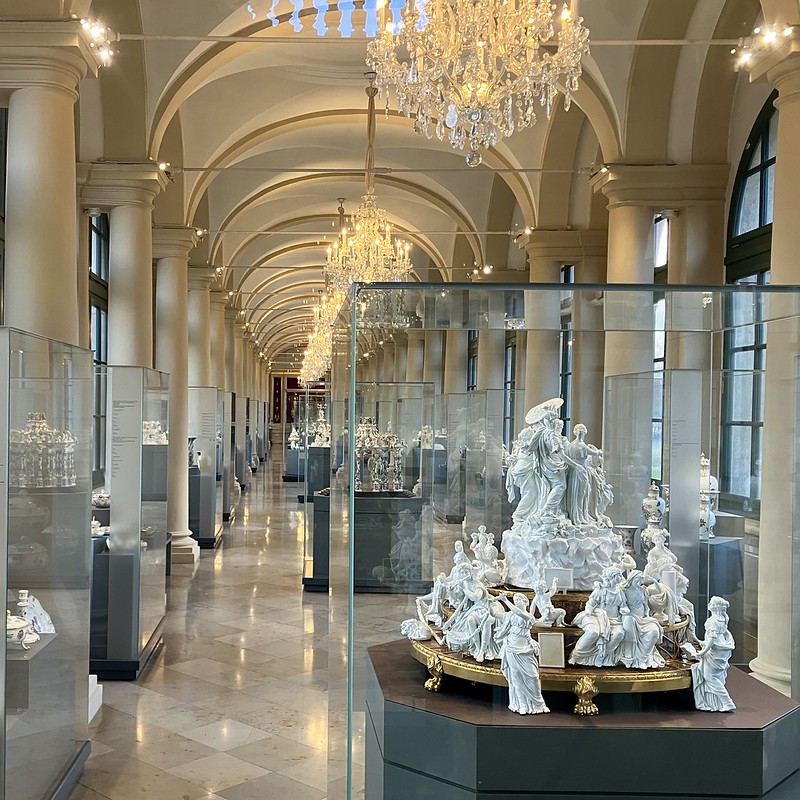
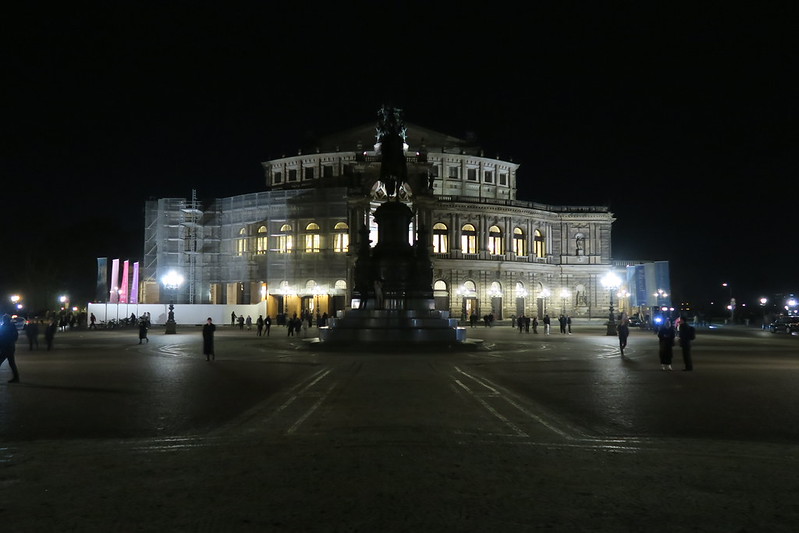
From there, the city opened out towards the river. We passed through the Brühlscher Garten and onto the elevated promenade of the Brühlsche Terrasse, where the Elbe slides quietly below and Neustadt hovers just beyond reach. We wandered through the courtyards of the Zwinger itself before circling back to the hotel for a restorative hot drink.
Refuelled, we set out again, this time making a direct visit to the Frauenkirche Dresden. Its reconstructed dome and patchwork stonework hold the emotional centre of the city and the surrounding Neumarkt felt calm and lived-in.
Crossing the Elbe, we entered Neustadt, heading up towards Albertplatz. Here the character shifts: broader streets, heavier civic architecture and residential quarters that invite unplanned turns. We wandered without agenda before drifting back down to the Königsufer, crossing Augustus Bridge and following the river’s edge once more.
The final stretch was a slow lap of the old town, before stopping to get dinner. It was a day defined less by ticking off sights and more by letting Dresden reveal itself step by step. As ever, this felt like a great way to get a feeling for the city.
On the morning of the last day, we took a quick final lap of the old town, grabbed our bags, headed to the station and caught the train towards Saxon Switzerland.
Saxon Switzerland
There are landscapes that announce themselves loudly and others that reveal their depth slowly, step by step. Saxon Switzerland belongs firmly to the second category. From Dresden, the train travels east along the Elbe, hugging the river as sandstone cliffs begin to rise from the water’s edge. The transition is subtle at first, then unmistakable: wooded slopes, sandstone rock walls and towers that look less like mountains and more like the ruins of some a forgotten city.
This is Saxon Switzerland National Park, part of the wider Elbe Sandstone Mountains that extend into the Czech Republic. It is a landscape shaped by time and erosion. Wind, water and frost have carved the sandstone into spires, gullies and ravines.
What makes it especially compelling is its accessibility. This is not wilderness reached only by car or long approach marches. It is a place where trains, ferries and footpaths interlock seamlessly. For travellers willing to move at walking pace, it offers the rare luxury of immersion without complication.
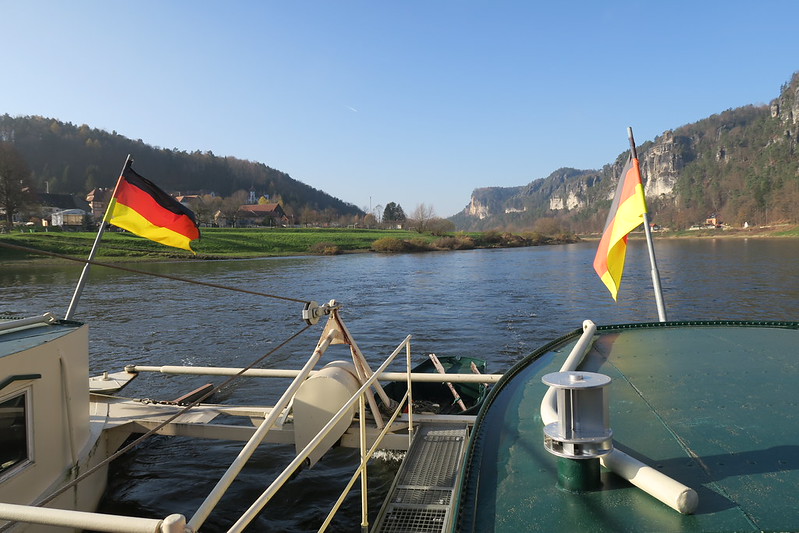
Our first destination was the Bastei, one of the most recognisable landmarks in the region. We crossed to the opposite bank of the Elbe from the train station to Rathen, using one of the river’s quiet marvels: a reaction ferry. The ferry has no engine. Instead, it is tethered upstream by a cable. By angling the rudder into the current, the ferryman allows the force of the river itself to carry the boat sideways across the water. It is an elegant piece of applied physics, silent except for the lap of the river against the hull. In a place defined by stone and water, it feels entirely appropriate.
From Rathen, paths lead steeply upward toward the Bastei Bridge, a nineteenth-century sandstone structure linking jagged rock towers more than 190 metres above the river. The bridge was originally wooden, later rebuilt in stone.
Nearby lie the remains of Neurathen Castle, once the largest rock castle in Saxon Switzerland. Carved directly into the stone, it exploited the natural defensibility of the towers and ravines. The site is now closed for safety reasons although even from a distance the outlines of walls and chambers are visible.
We carried on clockwise, moving with the flow of visitors as the path climbed toward the Bastei viewpoints. The crowds were not overwhelming although the atmosphere was unmistakably touristic: cameras raised, voices carrying, the rhythm of the path set by photo stops rather than footfall.
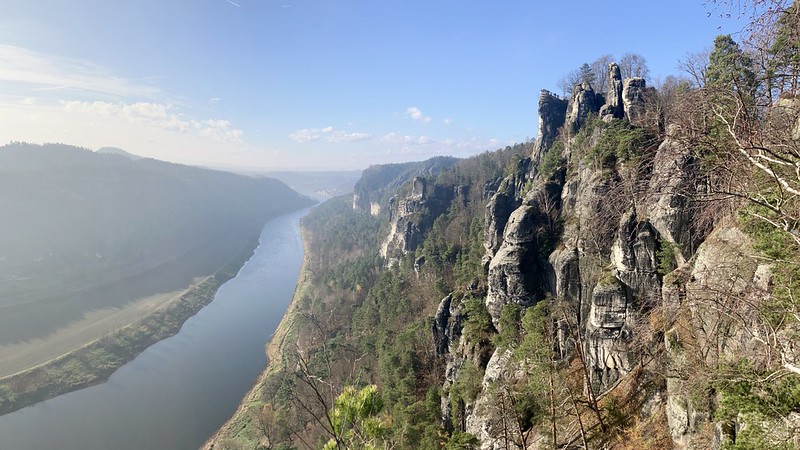
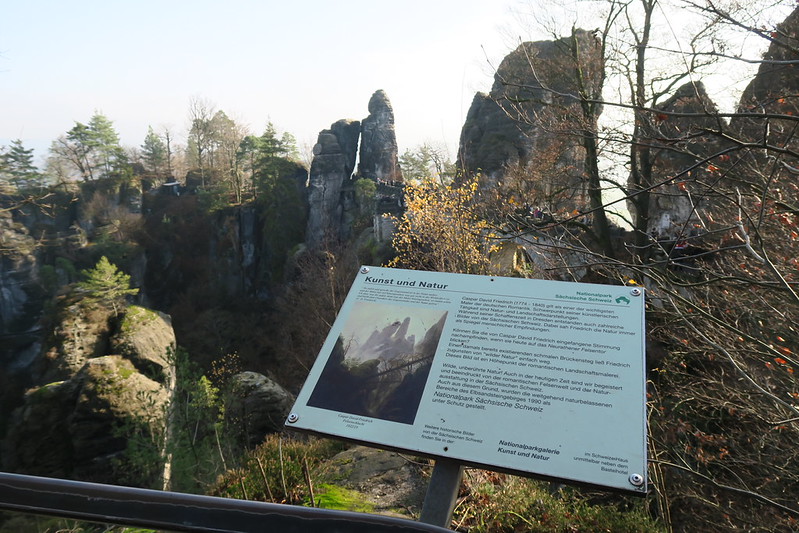
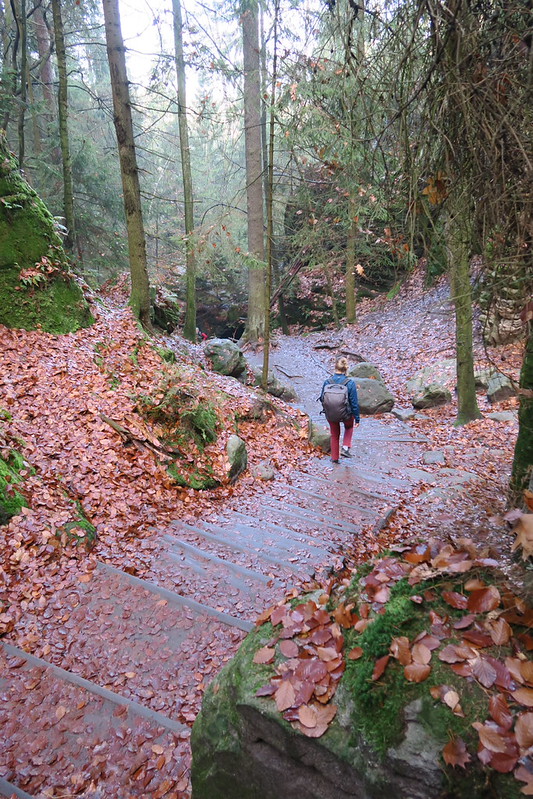
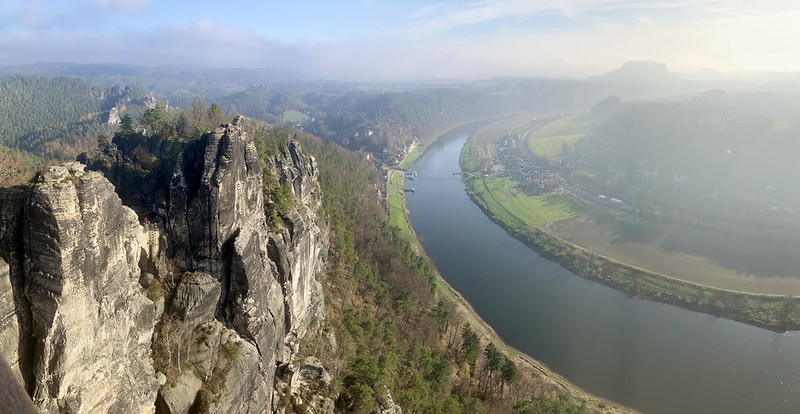
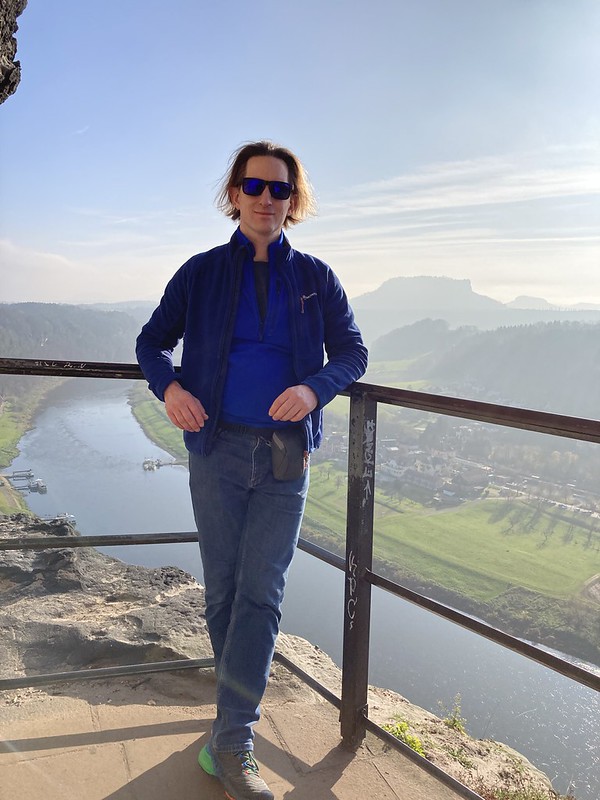
The views justified the attention. Sandstone towers rose in clusters. It was easy to see why this region has inspired painters, poets and later climbers. Although we saw no climbers that day, the formations themselves were enough to stir the imagination.
The real shift came when we left the main route. A smaller path peeled away from the viewpoints and dropped into the sandstone ravines. Almost immediately, the soundscape changed. Voices faded. Footsteps softened. The towering views were replaced by narrow corridors of rock and forest, where light filtered down in broken shafts and the scale of the landscape became something you moved through rather than looked at.
These ravines are the hidden heart of Saxon Switzerland. Cool, damp and intricately shaped, they encourage a slower pace and a different kind of attention. It was here, away from the postcard angles, that the landscape felt most alive.
We emerged near the Hotel & Restaurant Amselgrundschlösschen, tucked neatly at the foot of the gorge. It was the perfect place to stop for food.
After eating, we retraced our steps, reversing the ferry crossing. From there, we continued by train further down the valley, aiming for our base for the next few days. The plan was straightforward although travel days have a habit of offering small obstacles.
When we arrived at our next train stop, we discovered that the gap between train arrival and the next bus was almost exactly the time it would take us to walk. We had light packs and torches, so we chose to walk.
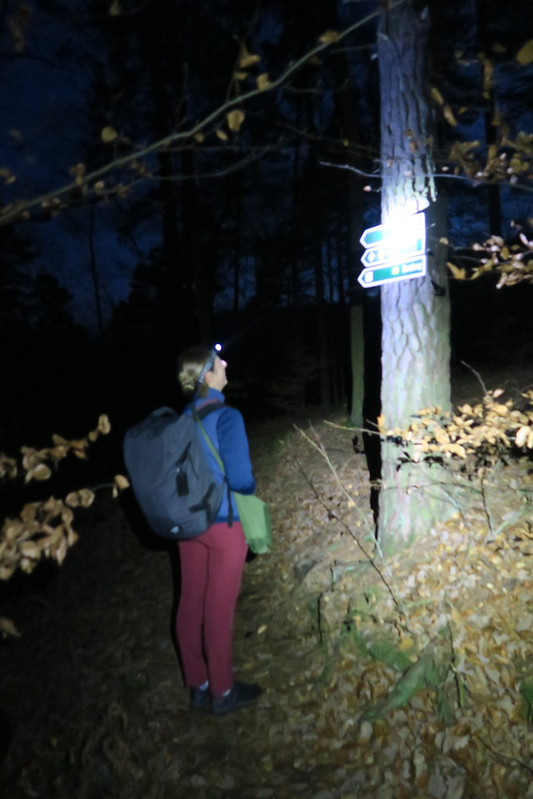
Komoot suggested a direct route to our accommodation, Hotel Grundmühle. Soon, we were ascending onto a wooded bank, headtorches ready as dusk tipped quietly into darkness.
The trail was dry and forgiving, the kind of path that encourages forward motion rather than caution. In our torchlight, the forest felt enclosed but not oppressive.
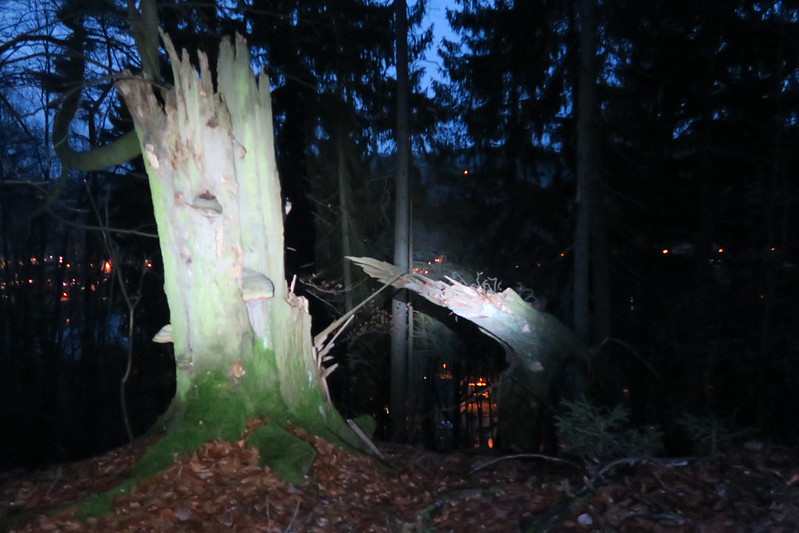
We passed a fallen “ghost tree,” long dead and partially collapsed, yet still hosting mosses, fungi and insect life. Its role as an oxygen producing organism had ended years ago, although its contribution to the forest had not. In a landscape shaped by erosion and renewal, it felt like a fitting symbol.
Old boundary stones appeared briefly at the edges of the path, their inscriptions softened by time. Waymarkers caught the light and disappeared again as we moved on. Gradually, the trail descended and the forest opened into a small, quiet settlement. This would be home for the next few nights
Check in was simple, and with it came an unexpected bonus: a local transport pass covering ferries, buses and trains throughout the region, including the train journey back to Dresden.
We took a short walk through the village by the river, noting ferry landings, footpaths and the limited food options available. There would be no abundance of choice here as mainly places looked closed for the winter.
We had already eaten well earlier in the day. With that, there was nothing left to do but rest. An early night followed, the good kind, earned rather than enforced.
A glance at the weather forecast shaped the day. The best conditions were still a couple of days away, so we deliberately chose the less promising window to visit Königstein Fortress. It felt like the right trade off: saving the clear skies for our walking day.
Königstein rises abruptly above the Elbe in the heart of Saxon Switzerland National Park, its sandstone table mountain transformed into one of Europe’s largest hilltop fortresses. From a distance, it looks improbable, like a city dropped onto a cliff. The walls alone stretch for more than two kilometres, enclosing not just buildings; it is an entire functioning settlement: barracks, workshops, wells, storehouses, parade grounds and viewpoints. This is not a single monument. It is a fortified town. Remarkably, it was never captured by force.
The first recorded fortifications on Königstein date back to the thirteenth century, although what we saw largely reflects centuries of continuous expansion by the Saxon state. From medieval stronghold to Renaissance citadel to early modern military complex, the fortress evolved in response to changing technology and political threats.
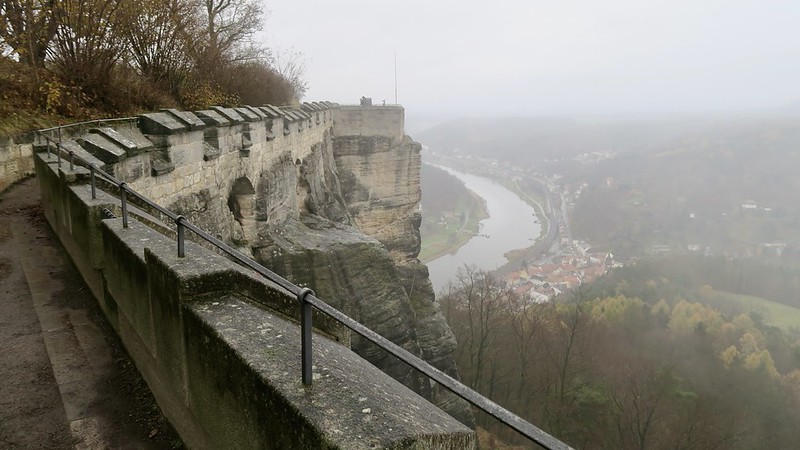
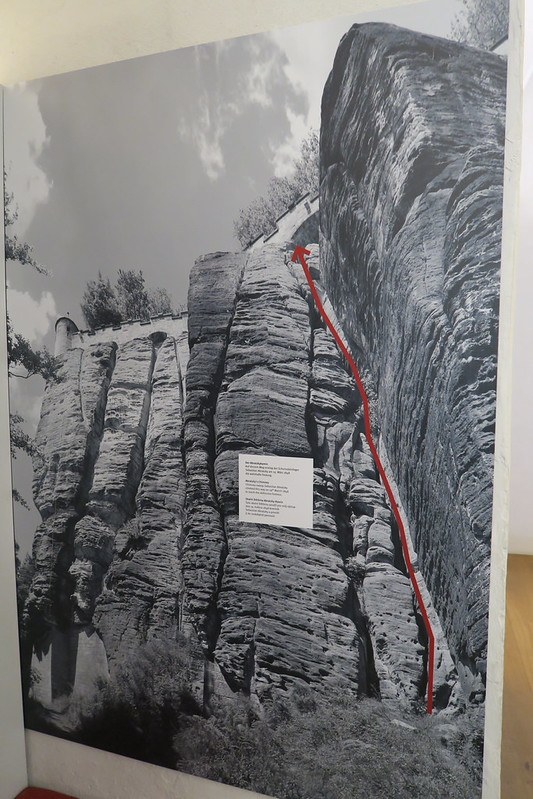
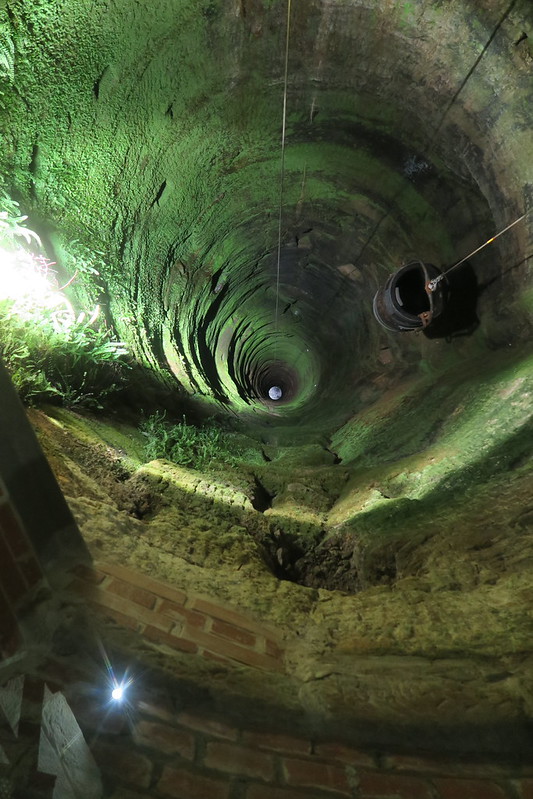
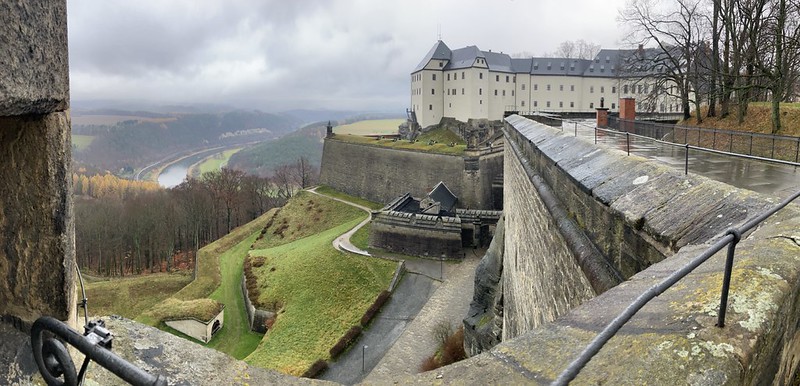
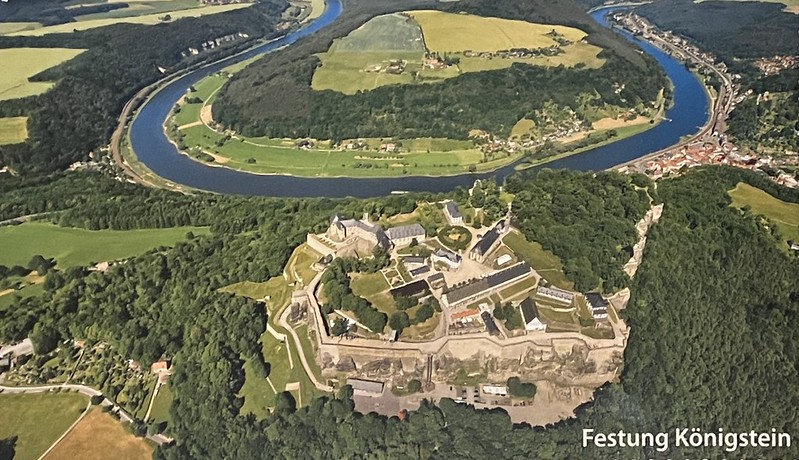
During both World Wars, it held prisoners of war, primarily officers rather than enlisted men and in the Cold War period it was absorbed into the military infrastructure of the GDR.
Walking the fortress today, those layers are easy to sense. You pass from wide, open parade grounds into cool casemates carved deep into the rock, then out again into light and wind. Exhibits are spaced throughout rather than concentrated in a single building, encouraging slow exploration rather than linear progression.
Cold eventually drove our decision making and the fortress offers a welcome pause at the Officers’ Mess. It’s easy to imagine officers dining here centuries ago, insulated from the weather by thick walls, yet always aware of the exposed world beyond them.
By mid-afternoon, the weather had turned properly wintry. A quick takeaway hot chocolate became essential rather than indulgent and we retraced our steps by train and bus back to the hotel.
For me, the highlight of the trip was still to come. The plan was: breakfast as soon as it started, packs already half sorted, then straight down to the ferry. Cross the Elbe, catch the bus and be walking before the day properly woke up.
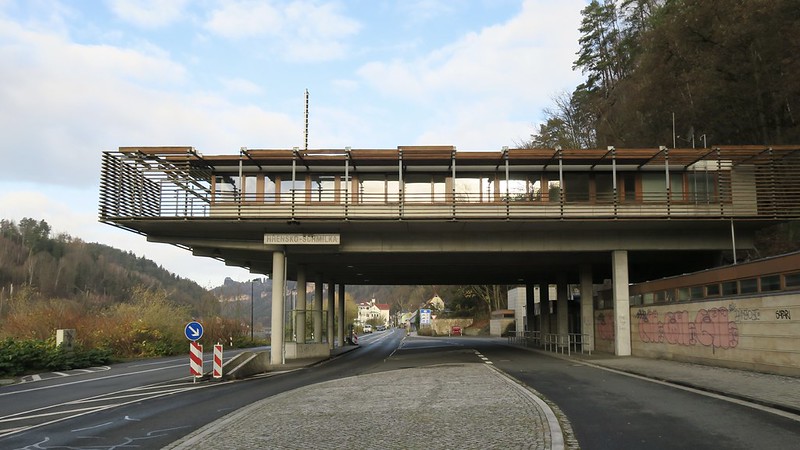
By mid-morning, we were stepping off transport at Schmilka, right on the edge of the Czech border. Border infrastructure still lingers here, quiet reminders of how divided this landscape once was and with a few steps we briefly crossed into the Czech Republic before looping back into Germany again.
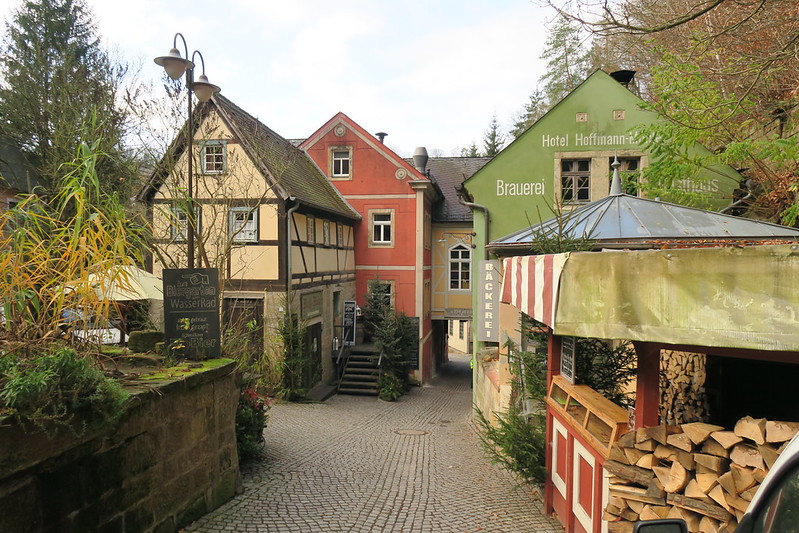
Schmilka itself was barely awake. It’s one of the most attractive villages in Saxon Switzerland: compact, traditional and framed by steep, forested slopes that rise almost immediately behind the houses.
On an information board for the Malerweg (the Painters’ Way) an illustration of the Schmilka Mill caught my eye. The artist was Adrian Ludwig Richter, whose nineteenth-century work helped shape how this region was seen and romanticised. That felt fitting. This is a landscape that rewards both movement and observation. Then it was time to head uphill.
From Schmilka, the path works its way into the narrow Heringsgrund before meeting the Heilige Stiege, the Holy Staircase. This is one of the classic ascent routes into the Affensteine massif and immediately sets the tone for the day.
It’s a steep climb of roughly 190 metres, tackled via a dense sequence of wooden and metal steps threaded through a sandstone gully. It’s not a via ferrata and there’s no technical climbing although it is very much hands on rock and ladders walking and the narrow walls amplify the sense of enclosure.
A short detour leads to Carolafelsen, one of the most celebrated viewpoints in the region. It’s a compact rocky platform perched among the towers and the panorama is immediate and expansive: forested plateaus stretching into the distance and layers of sandstone formations fading toward the horizon.
It’s popular for a reason. From here, the route commits to the ridge. The traverse across the Affensteine has a wonderful rhythm to it. Often described as a promenade, it runs high above the forest, threading between sandstone towers and opening repeatedly onto viewpoints.
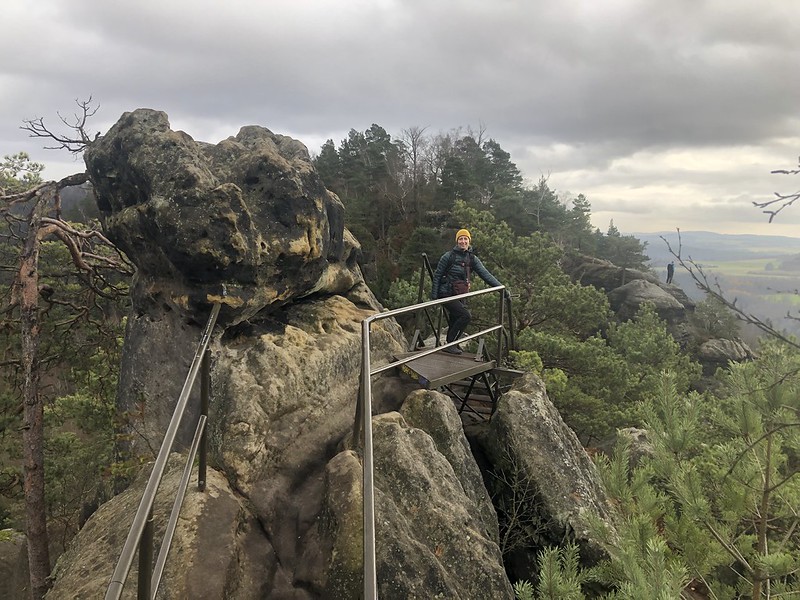
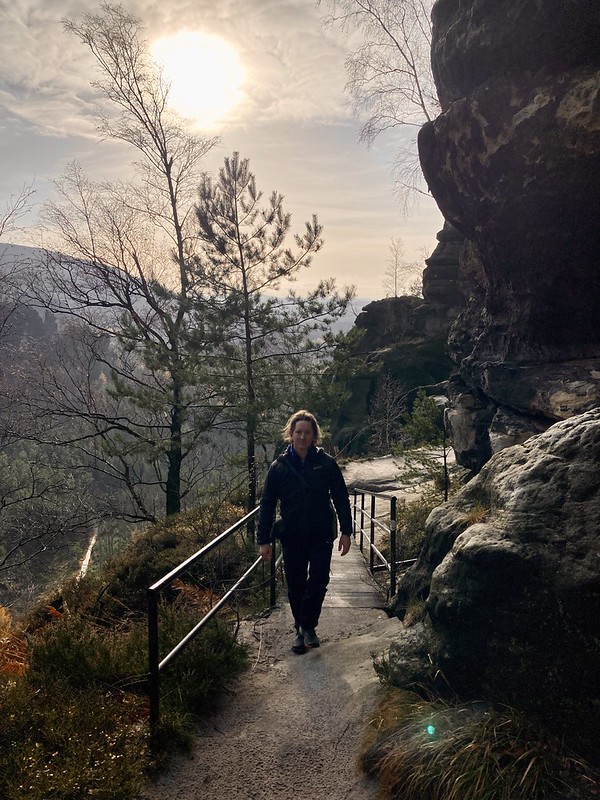
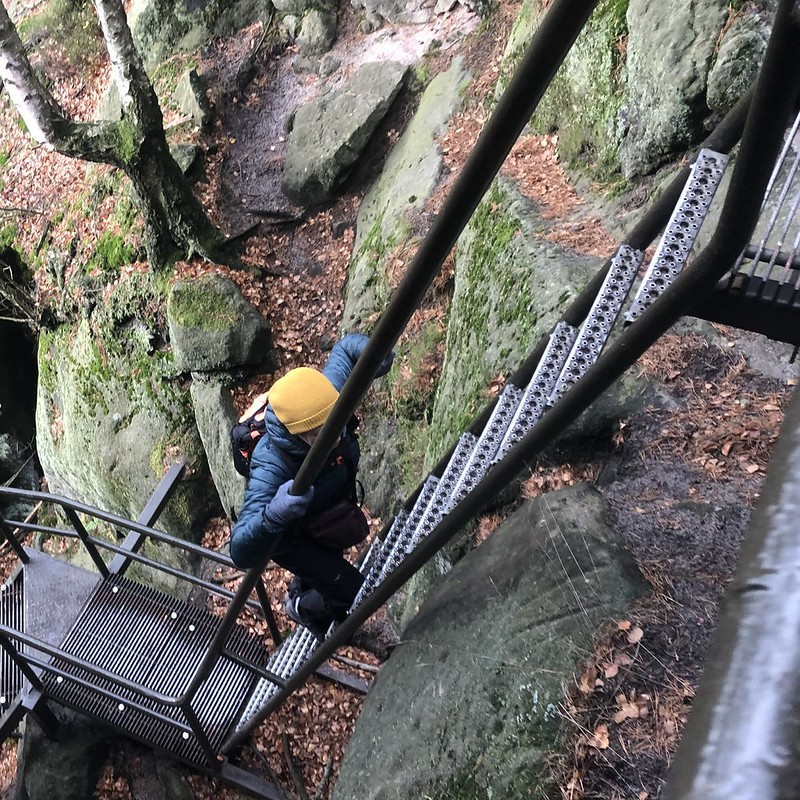
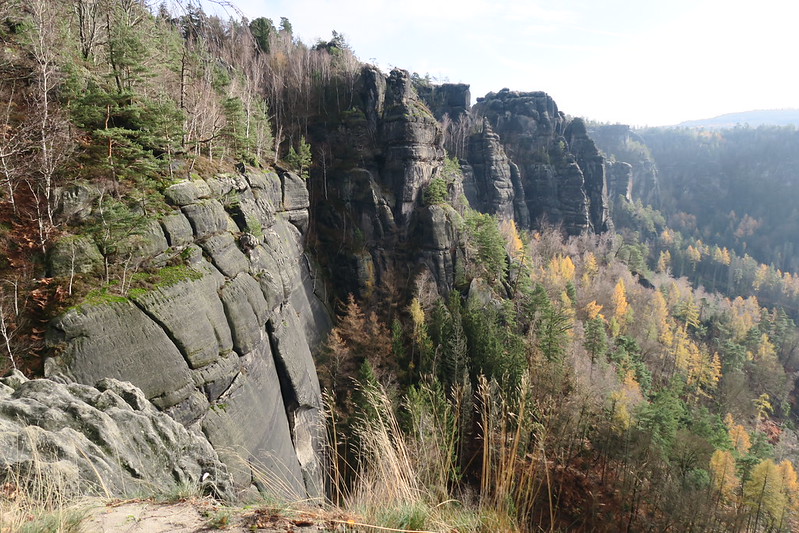
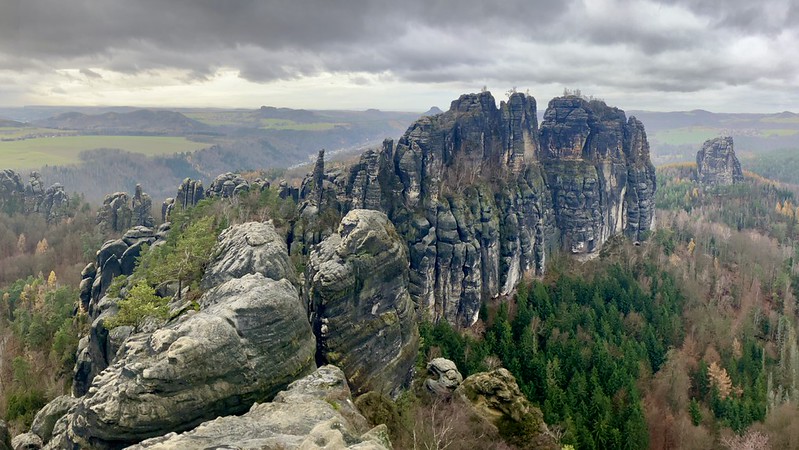
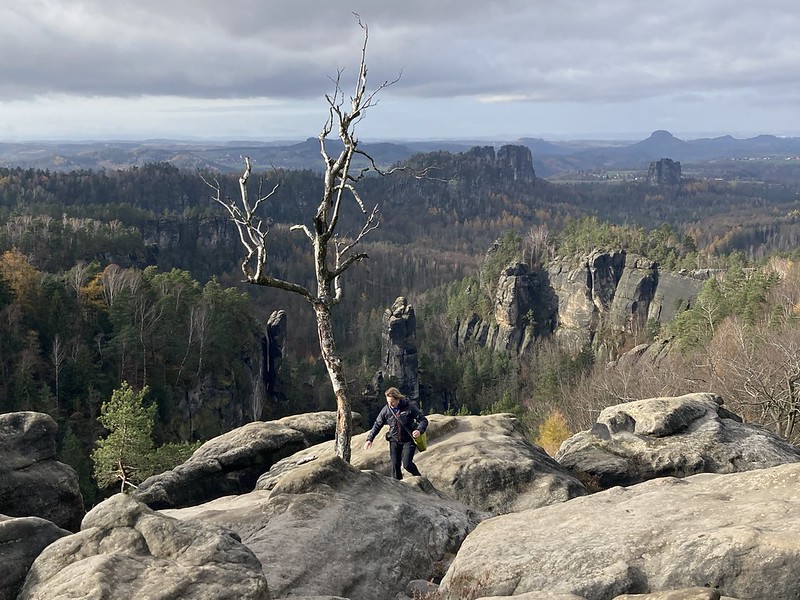
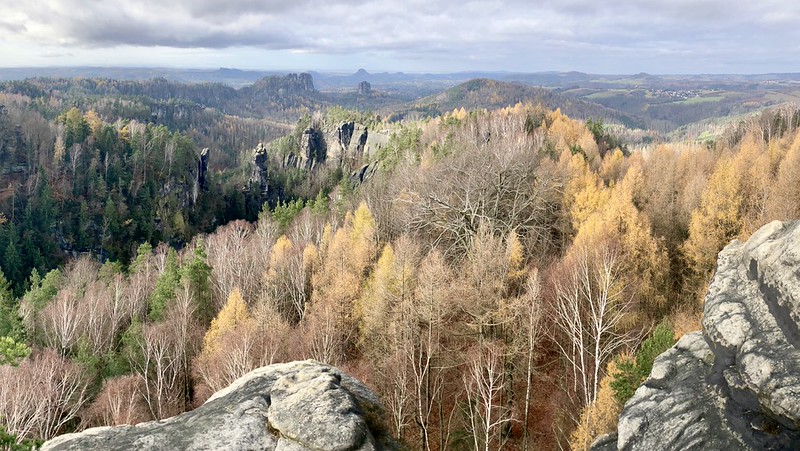
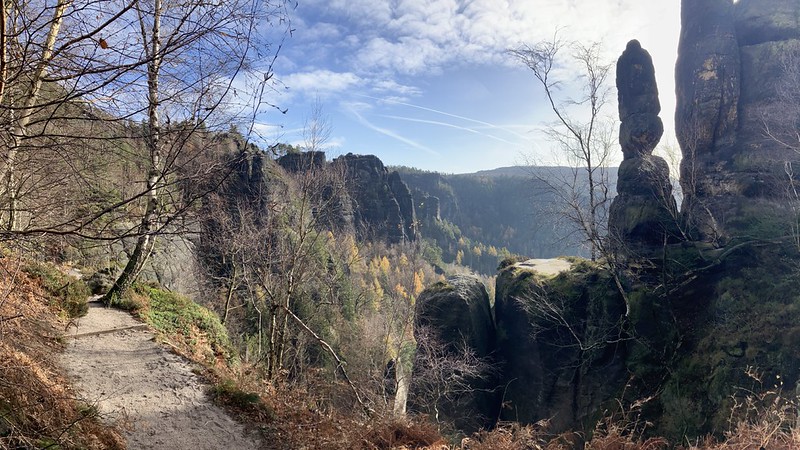
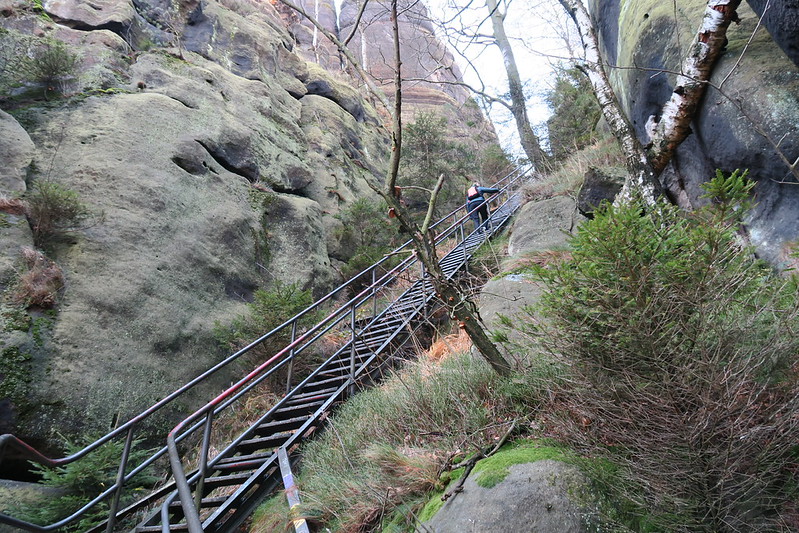
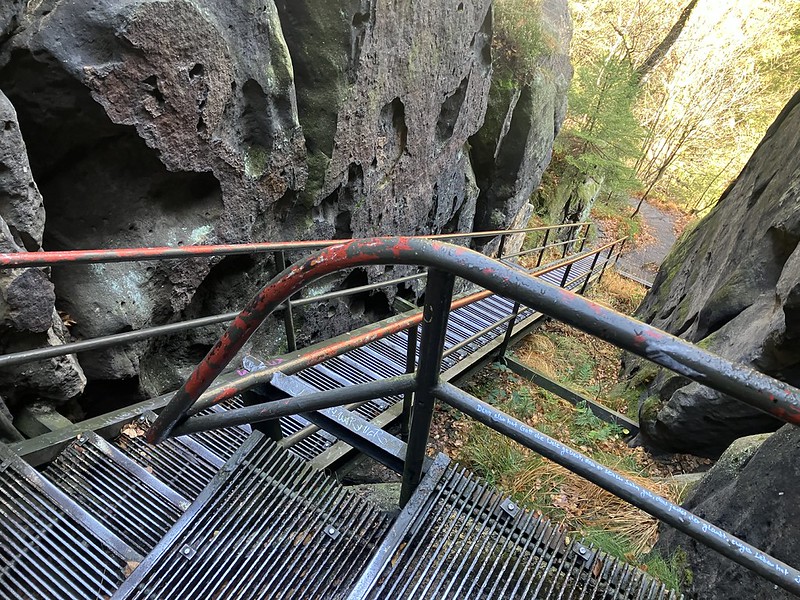
This is where Saxon Switzerland’s distinctive trail character really shines: narrow rock corridors, metal staircases, short ladders and passages. You’re rarely on open knife-edge ground, although exposure is constant in small doses. Enough to keep you engaged.
For anyone comfortable on UK Grade 1 scrambling terrain, it feels like a long, joyful puzzle: hands occasionally needed, feet placed carefully, eyes always pulled outward by the views.
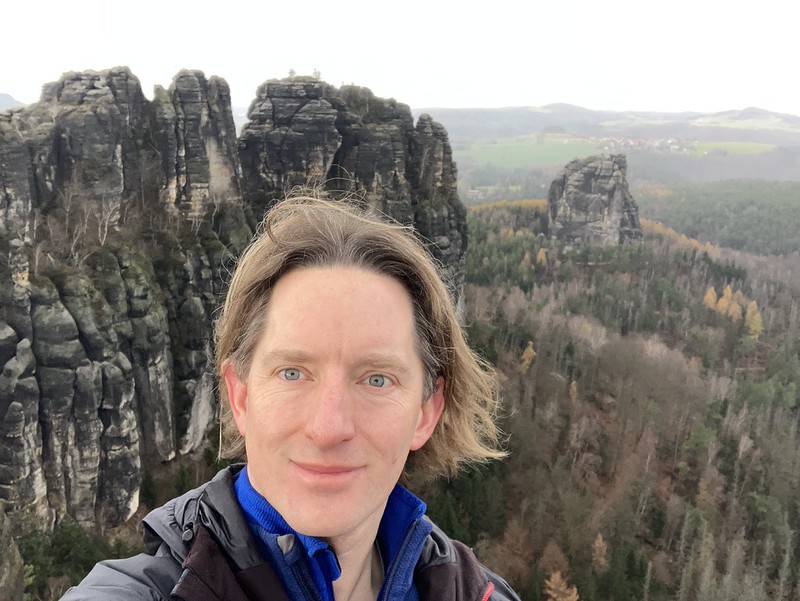
The Schrammsteine are iconic for a reason. This section is more concentrated, more dramatic and more memorable than almost anywhere else in the region. It’s exhilarating rather than technical although it demands calm movement and confidence with exposure. The reward is a sense of sustained elevation, that feeling of being among the towers rather than simply looking at them.
The descent toward Ostrau eases you back into civilisation, although not without more metal steps and ladders on the way down as it is quite steep in places.
From there, it was onward to Bad Schandau, where food and warmth were waiting. Sitting down at the Elbhotel Bad Schandau, the day finally caught up with us. One last ferry crossing took us back to Krippen, our base on the quieter side of the Elbe.
Wanting to make the most of our final day in Saxon Switzerland, we planned a couple of walks. First up was an early start, heading uphill before breakfast. Behind the hotel, a forest path climbs steadily towards the Kohlbornstein, a modest but well placed rock above the hotel. It’s not a headline viewpoint and that was part of its charm. In the dark of early morning, the climb was quiet until we drew close and found another small group with the same sunrise idea, yet there was space enough for everyone.
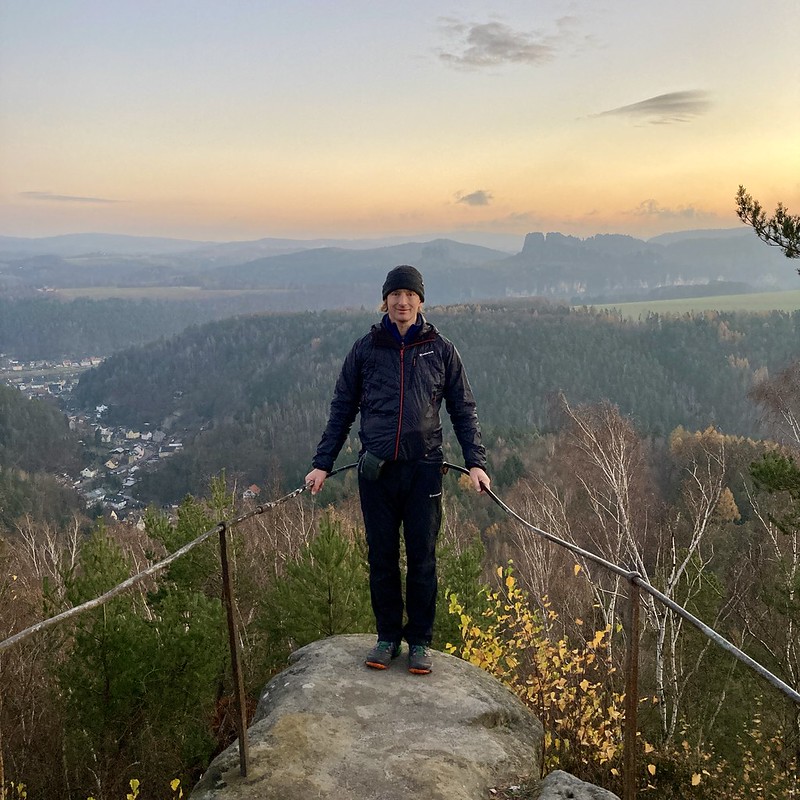
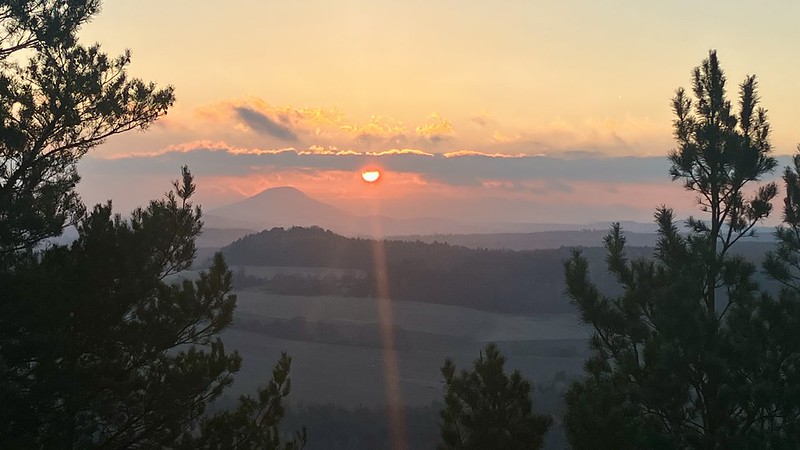
From the rocks, the Elbe valley slowly came into focus. It was a gentle, unforced way to say goodbye to the landscape. Back down the hill, breakfast tasted better for the early effort. Bags were packed, our room vacated and soon we were moving again.
The plan was to cross the river, get the bus to Schmilka, and walk back. A small mishap on my part saw us stepping off early in Ostrau. Rather than treating it as a mistake, we leaned into it.
Ostrau sits on a plateau above Bad Schandau and from here the route naturally leads to a low level hike below the bottom of the rock formations and headed towards Schmilka, which was lovely gentle day compared to the ladders of the previous day.
From Schmilka, we joined a very busy bus back towards town. Walkers, day trippers and locals packed the seats.
Determined to squeeze the most out of the day, we got off the bus a little early and caught our longest ferry crossing of the trip, gliding across the Elbe from town to the railway station on the opposite bank. Then the train arrived, the doors closed and Saxon Switzerland slipped quietly behind us.
The return to Dresden was swift. After days of forest paths and riverbanks, the city felt momentarily abrupt. I had one very specific plan in mind: egg fried rice from the food hall. That plan failed immediately. It turned out to be a regional public holiday and much of the city had quietly shut down So food was found elsewhere. We checked in and all that remained was a good nights sleep and a gentle wander in the morning before getting the train to Berlin.
Berlin
I was a little boy when my family were stationed in western Germany. One of my earliest memories is travelling the Berlin Corridor through East Germany to visit Berlin. Checkpoint Charlie, the museum and those stories of desperate escape attempts… at the time it wasn’t “history”; it was simply what was happening around us.
Families split overnight by the wall appearing. People risking everything to get to the West. A divided city, with British, French and American sectors on one side and the USSR sector on the other. In Berlin, the boundary was at its narrowest, sometimes just a strip of water or land, with only a handful of crossing points. Checkpoint Charlie was the main one for visitors like us heading into East Berlin for the day.
On that first trip. What do I actually remember?
The feeling of being on edge as the Americans checked us out of the West before we drove the corridor route to Berlin through East Germany. Years later, I found out they timed those transits, in case someone had to come looking for you.
I remember the escape stories from Checkpoint Charlie, especially the harrowing tale of the family who built a giant hotair balloon. And most of all, I remember my dad putting on his full uniform, not his usual blue jumper from days on the airfield racing around in his Land Rover. That alone made the day feel serious.
Crossing over to East Berlin… and bang, the graffiti of the western side replaced by defences, towers, people watching. I had no idea then that there were automated systems behind all that too. Looking back, what an experience.
My memories of East Berlin are vague; I was very young. A wander around, maybe a café stop although the impact stayed with me. How two places, separated by such arbitrary lines on a map, could feel so utterly different.
After all my years working across Europe as a consultant, helping organisations on their data journeys, it feels strange that I never made it back to Berlin until now. Nearly forty years later, it was time to return, this time with a map of where the wall once stood. So here we go: exploring places that were once off limits, walking ground that lay beneath the boundary, visiting so many landmarks as we wandered through the sunshine and cold November air. There’s just enough of the wall left to remind us of what happened, even as a resilient city has rebuilt and absorbed so much of it.
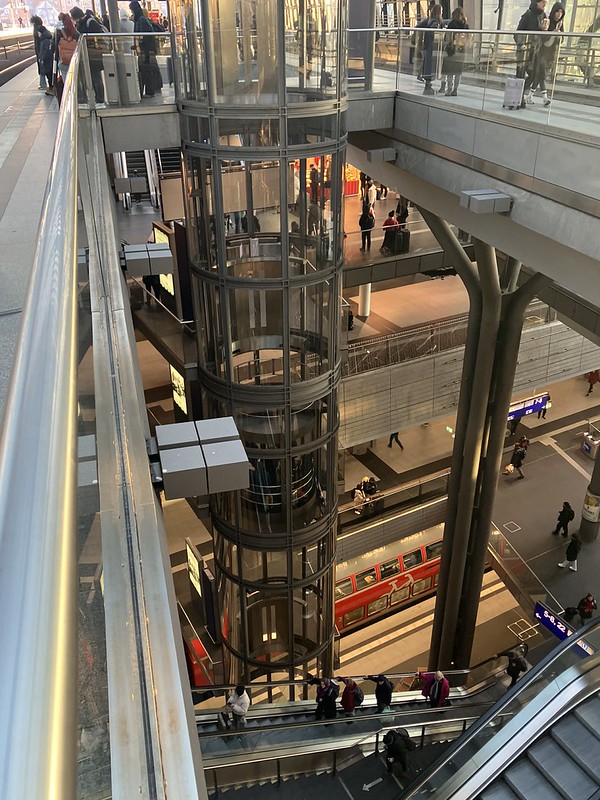
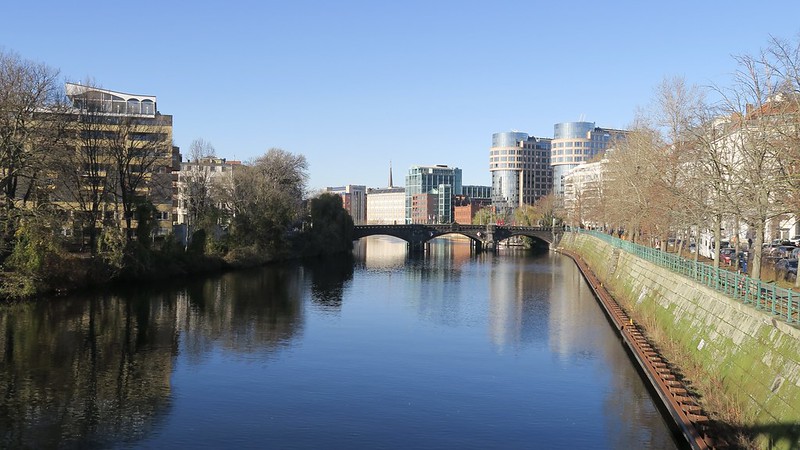
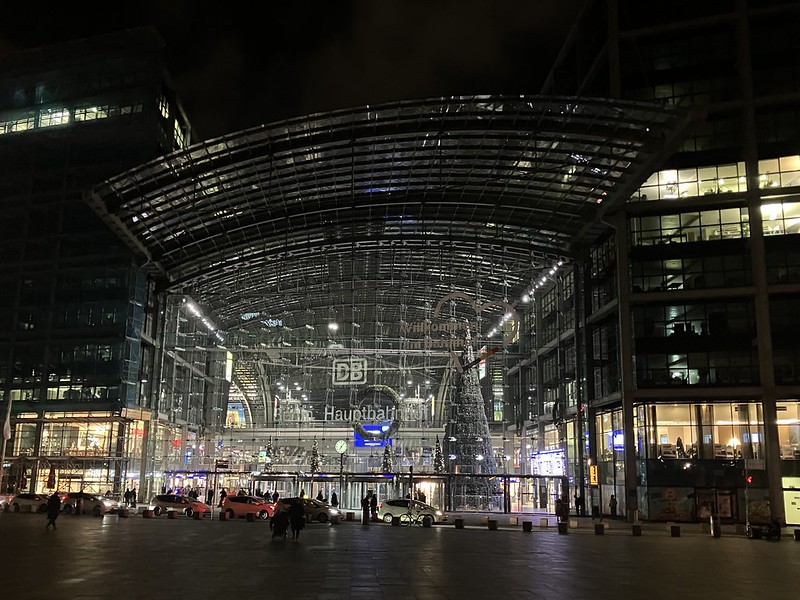
We arrived in Berlin from Dresden at Berlin Hauptbahnhof, the city’s vast glass and steel gateway. It’s an arrival point that feels deliberately modern. From there, we did what always feels right for us in a new city; we walked. There’s something liberating about stepping out with a light bag and no immediate agenda beyond movement, letting the streets do their slow work of introduction.
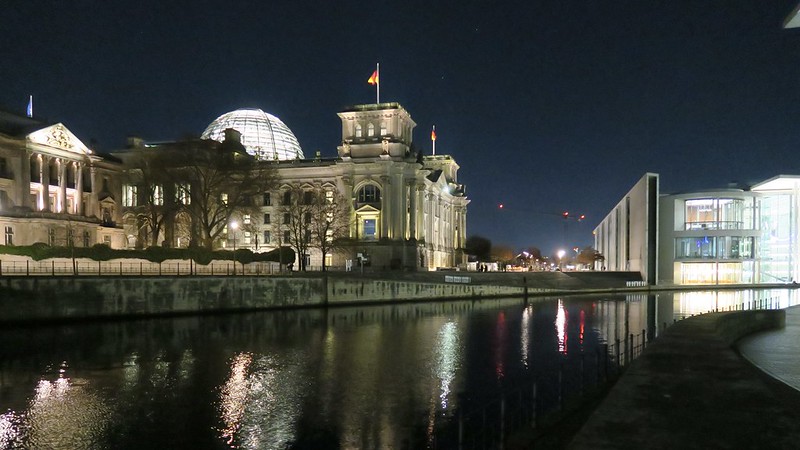
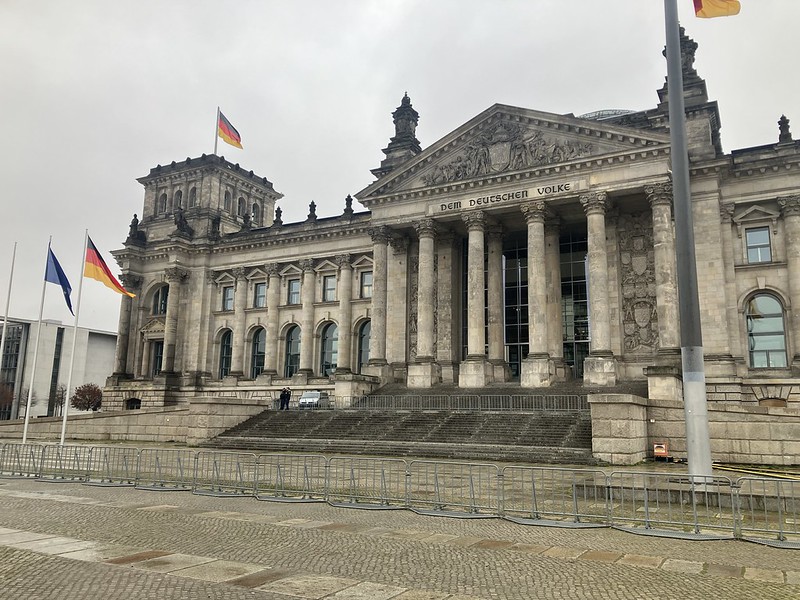
We crossed the river and very quickly the Reichstag Building appeared, impossible to miss, both physically and symbolically. The stone façade carries the weight of history, while the glass dome above speaks clearly of a post war determination toward transparency and accountability. We didn’t linger long. Berlin felt to work best when we kept moving.
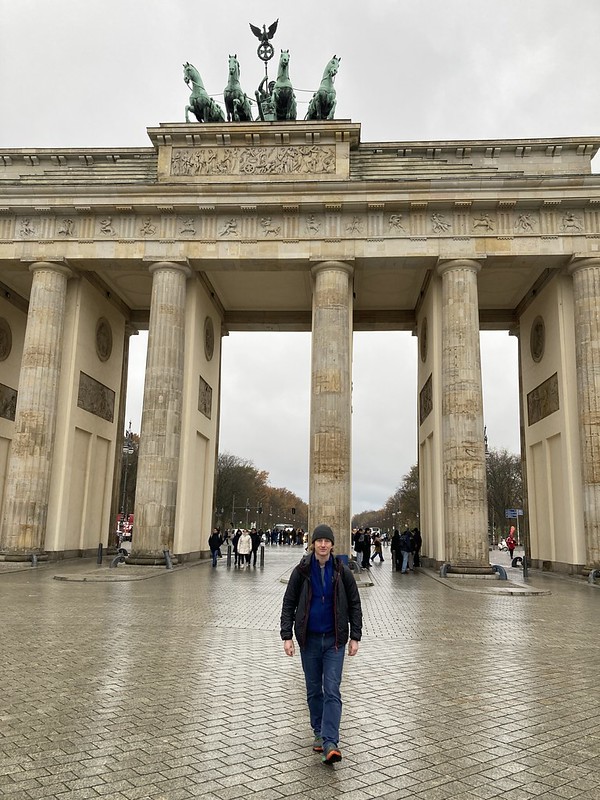
From the Reichstag, our route pulled us naturally toward Brandenburg Gate. We walked through it, not just photographed it. Once a Prussian triumphal arch, later sealed by the Wall, now open again. It felt like a place that only really makes sense when you pass through it on foot.
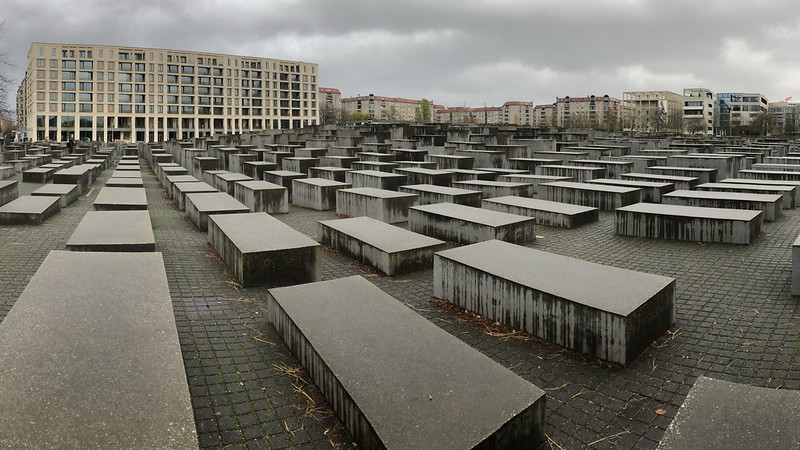
A few minutes away, the mood shifts sharply at the Memorial to the Murdered Jews of Europe. The field of concrete stelae is disorienting, silent and unavoidable. From there, we passed the Beethoven, Haydn, Mozart Memorial and continued toward the Soviet War Memorial, a reminder that Berlin’s story is never just German; it’s layered with occupying powers, ideologies and aftermaths.
We kept walking, this time toward our hotel, to check in. Bags dropped. That late afternoon, we followed the river again toward the edge of Museum Island. The museums sit calmly now in what was once the Soviet sector.
Nearby, Neue Wache offered a moment of stillness. Käthe Kollwitz’s Mother with Her Dead Son strips remembrance back to something universal: grief without politics. As night settled, we wandered along softly lit streets, past monuments and quiet corners, before finding food and rest after a day spent entirely on foot.
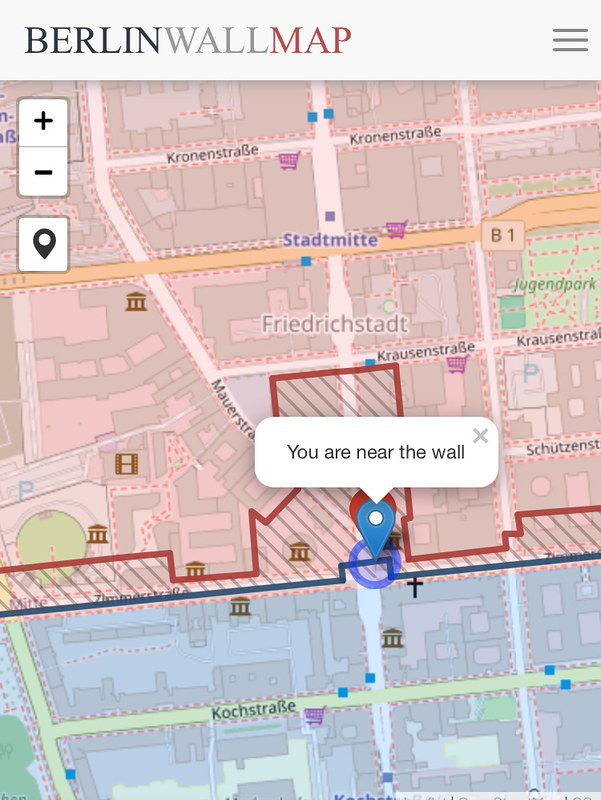
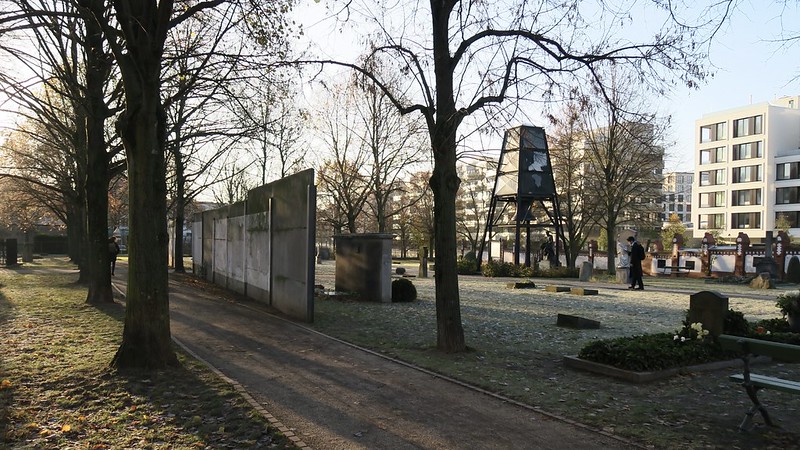
The second day began north of the centre at Invalidenfriedhof, where military history and personal loss sit side by side and where relics of the Berlin Wall survive. We passed the Gedenkstätte Günter Litfin watchtower, dedicated to border victims, before the route naturally joined the Berlin Wall Trail, the Mauerweg. We roughly followed the line of where the wall once stood, using the Berlin Wall map as a guide (https://berlinwallmap.info/map/). In many places, the wall has been fully absorbed into the city, though traces remain if you look carefully.
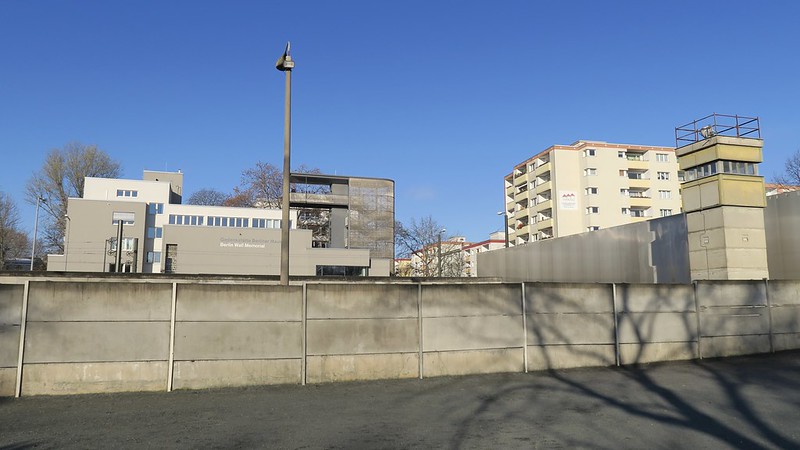
At the Berlin Wall Memorial, the story becomes explicit again. Preserved sections, watchtowers and open ground give shape to what was once lethal emptiness.
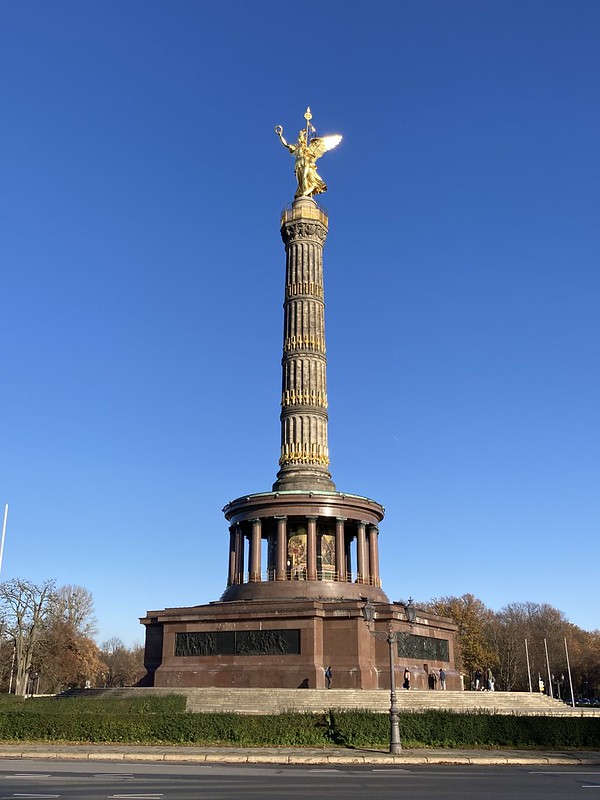
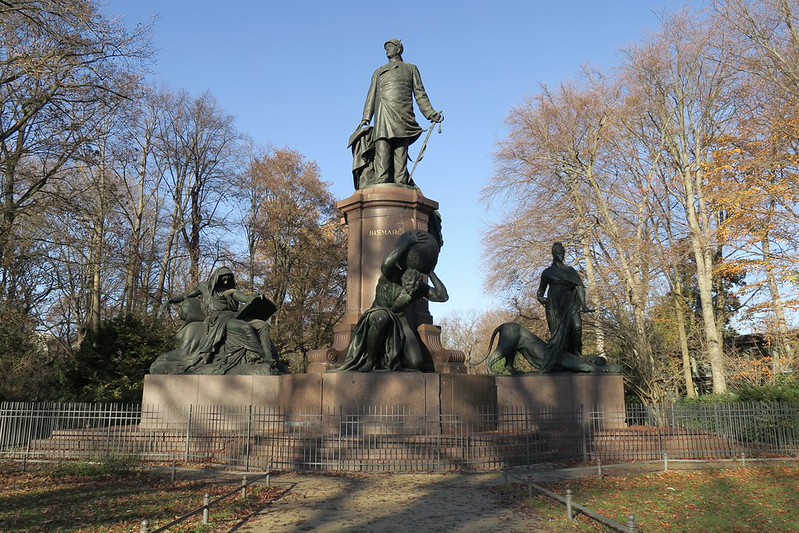
From there, we returned to the river and headed west, following the Spree until it pulled us into Tiergarten once more. The park feels like a pause in Berlin’s intensity. Deep inside it stands the Bismarck National Monument, heavy, symbolic, unmistakably Prussian. Not far away, the Victory Column (Siegessäule) catches the light and tourists’ attention.
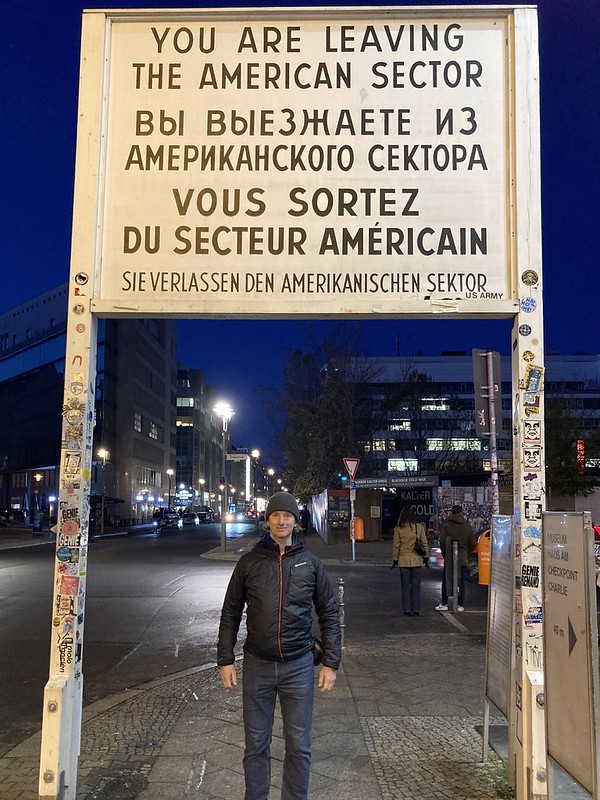
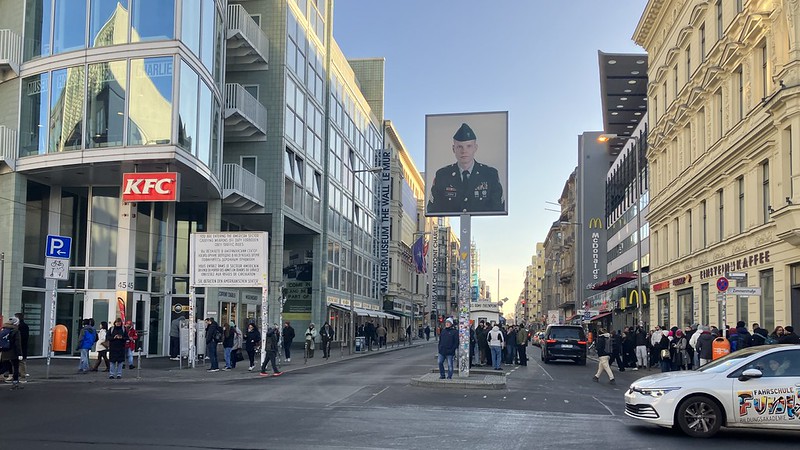
From there, we turned toward Checkpoint Charlie. The signage remains, though the atmosphere has changed since my childhood visit. What was once tense and procedural is now crowded and commercial, though the history still presses in, both outside and inside the Checkpoint Charlie Museum.
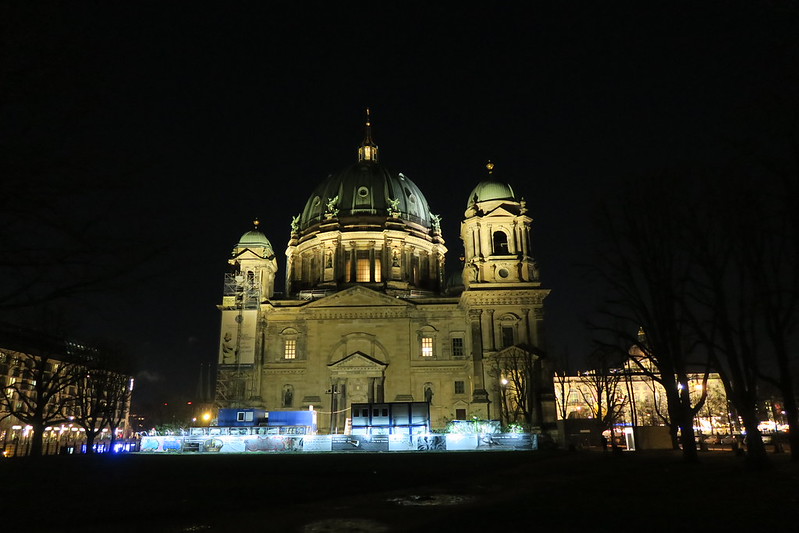
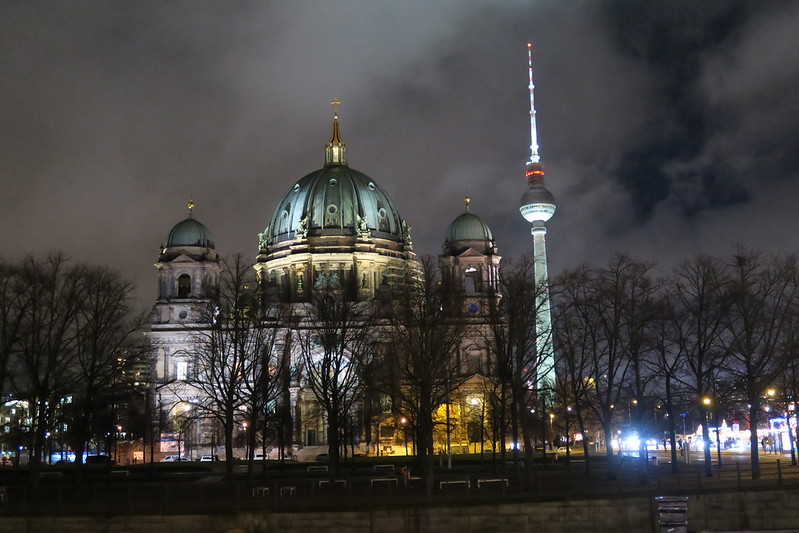
We then cut back across Museum Island, paused at Berlin Cathedral and listened to buskers on the bridge as the city eased into evening once more. Dinner ended up back where we began: Berlin Hauptbahnhof.
On the final morning, we took one last short walk through Invalidenfriedhof to the Gedenkstätte Günter Litfin watchtower, a quiet closing gesture. Then it was bags, trains, airport and a long but smooth journey home via Heathrow.